I’ve priced enough pond projects to know that material costs tell only part of the story.
When you’re standing at the edge of a half-excavated basin, watching a crew weld 40-mil HDPE seams against a hexagon-tiled backdrop of compacted clay, the difference between $0.35 and $3.00 per square foot suddenly feels personal.
Your choice shapes decades of filtration, pervious seepage control, and whether that stone pillar fountain you envisioned stays level through freeze-thaw cycles.
Seven distinct breakdowns wait below, each with hidden variables that could redirect your entire budget.
Farm Pond Liner Cost Per Square Foot: 2025–2026 Ranges
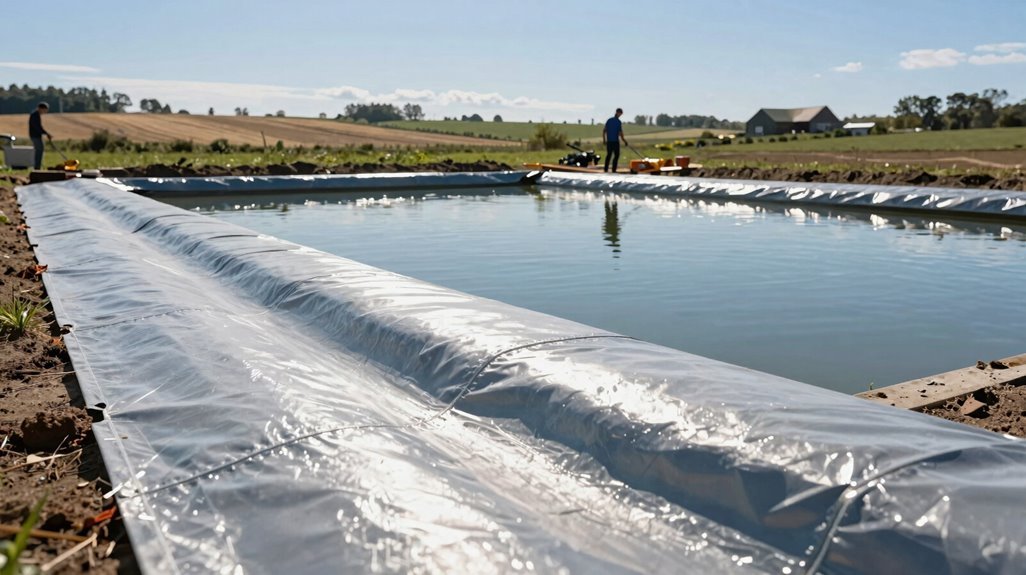
How much should you actually expect to pay when lining a farm pond in 2025 or 2026? I’ve crunched the numbers, and material costs for farm pond liners range from $0.28 to $3.00 per sq ft, while installed cost climbs to $0.50–$5.00 per sq ft.
Let me break down your options. HDPE runs $0.35–$1.20 per sq ft for 40–60 mil thickness, delivering 20–40 years of service against a hexagon-tiled backdrop of aquaculture demands. PVC offers $0.28–$0.70 per sq ft, a budget-friendly 20–30 mil choice lasting 8–15 years. EPDM commands $0.90–$3.00 per sq ft, its 30–60 mil flexibility conforming to irregular shorelines like a stone pillar fountain’s base.
Your total installed cost per sq ft incorporates excavation, underlayment, welding seams, and labor; each variable shapes your project’s final investment.
Why Installed Costs Exceed Material Costs Alone
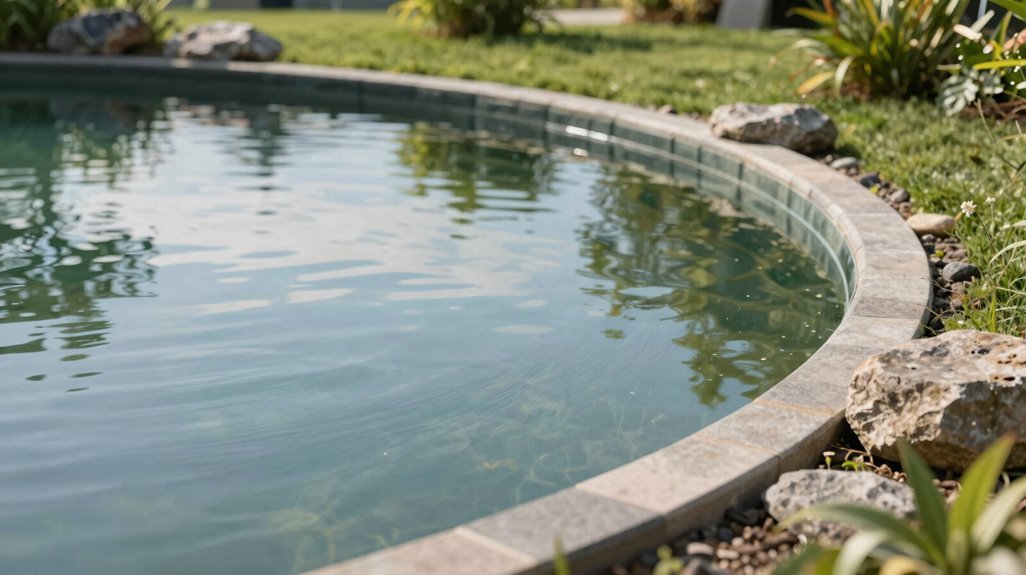
I want you to picture a crew arriving at your property with rolls of EPDM sheeting, because that material sitting in your driveway isn’t going anywhere without significant added expense. Labor and welding alone can tack on $0.20 to $1.90 per square foot, with technicians heat-seaming seams along a hexagon-tiled backdrop of compacted stone while you watch the meter run on specialized equipment.
Site preparation needs, stripping topsoil, grading slopes, installing pervious geotextile layers for filtration and puncture resistance, combine with transportation logistics hauling heavy liner rolls across county lines to turn your $0.30 material into a $2.50 installed reality before the first koi swims.
Labor and Welding
Why does a pond liner’s final bill so often surprise first-time buyers? I’ll show you where your money actually goes. Labor runs $0.15–$1.50 per sq ft, while welding adds another $0.05–$0.40 per sq ft; together these transform a simple material purchase into a skilled installation. Watching a technician fuse EPDM seams with a hot wedge, I see why: precision prevents leaks. Underlayment, at $0.05–$0.30 per sq ft, protects those welds from stone punctures beneath the black membrane.
Your installed cost reflects this craftsmanship, not just the roll of rubber. Smaller ponds hurt most per sq ft, lacking economies of scale. Understanding these numbers, you’re now equipped to budget like an insider, not a stranger to the trade.
Site Preparation Needs
Where does your pond liner budget actually disappear before the first sheet touches soil? Site preparation demands more than you’d expect, and I’m here to walk you through where your money actually goes.
Excavation cost runs $0.10 to $1.20 per square foot, often consuming the largest slice of your initial investment, especially when I’m shaping larger ponds with irregular contours. You’ll need geotextile underlayment at $0.05 to $0.30 per square foot, creating that critical buffer between sharp stone and your membrane.
Welding/seaming adds another $0.05 to $0.40 per square foot, growing more labor-intensive around hexagon-tiled backdrops and curved edges. Labor cost itself spans $0.15 to $1.50 per square foot, reflecting crew expertise and site accessibility challenges. Transportation cost, ranging from $150 to $2,000+, further separates material price from true installed reality.
Transportation Logistics
How does a $3-per-square-foot liner balloon into $8 before water ever touches it? I’ve watched this math surprise too many pond builders.
Transportation alone can drain $150 to $2,000 from your budget, especially when that massive rubber roll winds through narrow access roads to reach your hexagon-tiled backdrop site. Add installation labor at $0.15 to $1.50 per sq ft, plus underlayment ($0.05 to $0.30) and welding/seaming ($0.05 to $0.40), and your liner material becomes just one piece of the puzzle.
These elements stack 0.28 to 0.50 per sq ft atop raw costs, pushing total installed cost per sq ft 10 to 30% beyond material alone. Even with economies of scale on oversized ponds, logistics complexities often claw back those savings.
HDPE vs. LLDPE vs. PVC vs. EPDM: Price and Durability Compared
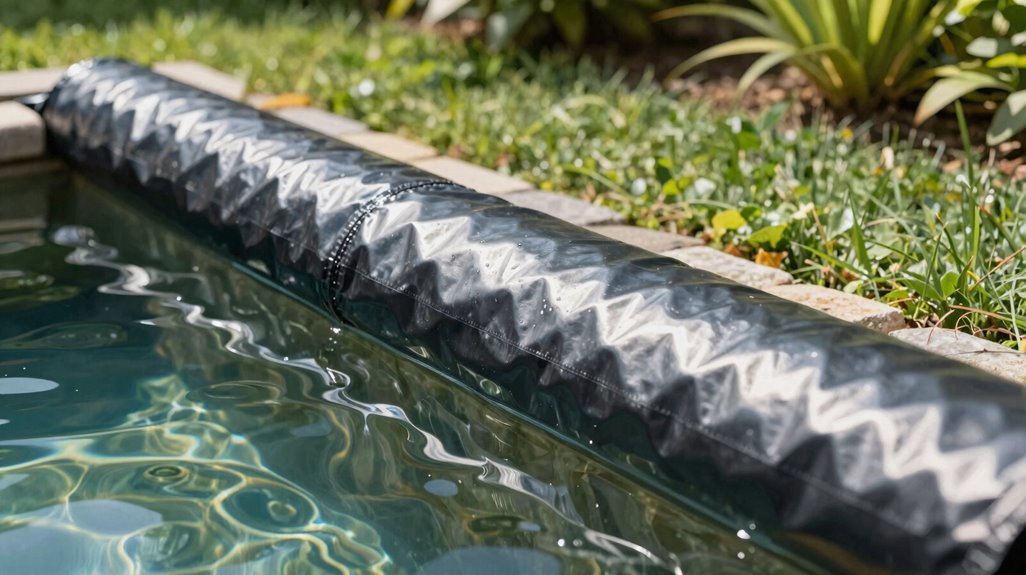
When I’m choosing a pond liner, I always start by weighing what I’ll spend against how long it’ll hold up. The cheapest option upfront often cracks under pressure when frost heaves push against thin PVC or UV rays bake it brittle across three summers.
- HDPE ($0.35–$1.20/sq ft): 20–40 years of pond liner durability, UV-resistant, hexagon-tiled backdrop installations
- LLDPE ($0.30–$0.90/sq ft): 15–25 years, flexible for medium ponds with stone pillar fountain features
- PVC ($0.28–$0.70/sq ft): 8–15 years, pervious to cold damage, budget-friendly but temporary
- EPDM ($0.90–$3.00/sq ft): 20–35 years, excels in irregular shapes, superior filtration compatibility
Balancing cost per square foot against decades of service, I gravitate toward HDPE for large, permanent water features where reliability matters more than initial savings.
Which Liner Material Matches Your Farm Pond Use Case
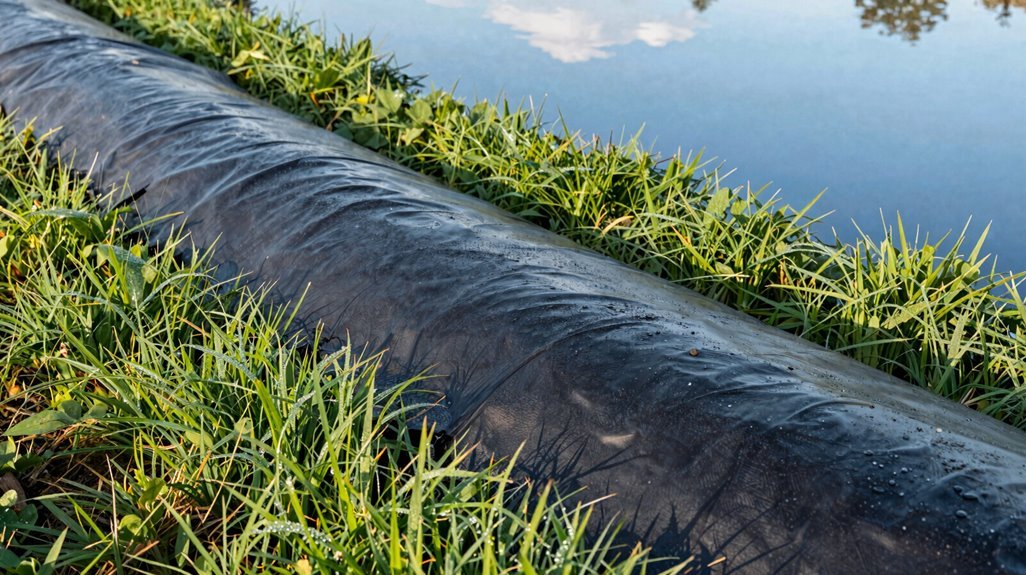
Why settle for a liner that fights against your land’s natural contours when you can match material to purpose? I see your farm pond vision clearly, perhaps a hexagon-tiled backdrop against weathered barn wood, water lilies drifting near a stone pillar fountain.
For expansive, permanent installations, I reach for HDPE. Its square foot rate runs $0.35 to $1.20 for material, with installed pond liner cost reaching $5.00 per square foot, worth every penny for decades of pervious, reliable containment.
Got irregular depths or koi aspirations? EPDM flexes beautifully, though you’ll pay $0.90 to $3.00 per square foot.
Watching my budget tightly, I might gamble on PVC at $0.28 to $0.70 per square foot, accepting shorter filtration protection.
For premium longevity with impeccable seams, Butyl commands $1.20 to $2.50 per square foot.
How Pond Size Changes Your Cost Per Square Foot
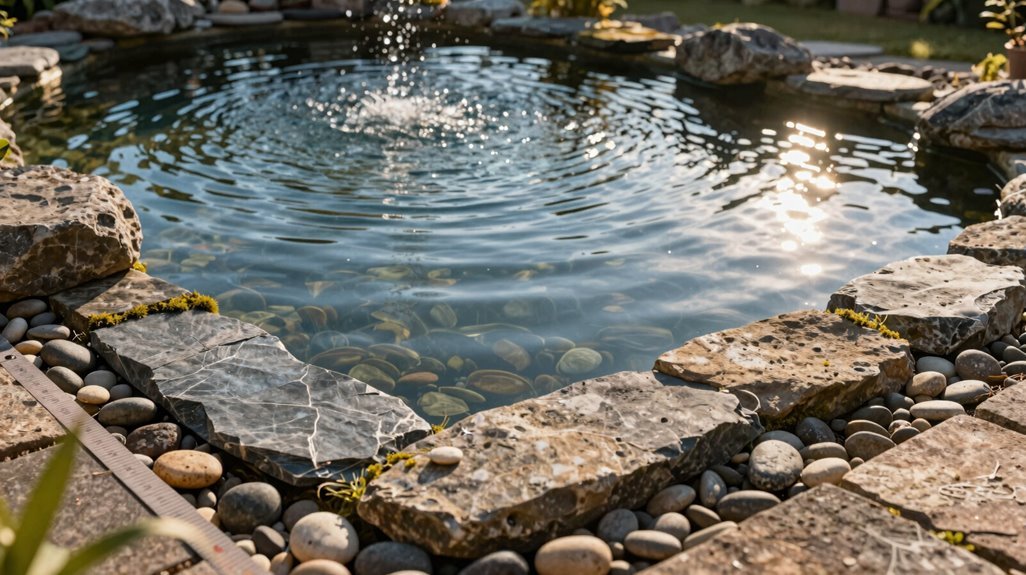
Where exactly does your farm pond vision land on the scale between modest water feature and small lake? I’ve watched pond liner cost shift dramatically as pond size expands, and you’re about to see why bigger often means smarter spending.
A 50×50 ft pond spreads fixed costs across 2,500 square feet, dropping your cost per square foot below tiny backyard projects. One-acre ponds (43,560 sq ft) deliver material costs of $10,000–$35,000 with installed costs reaching $20,000–$110,000, proving massive economies of scale.
Transportation, mobilization, and welding expenses shrink proportionally as your project grows, amortizing fixed costs efficiently. Irregular hexagon-tiled backdrops or stone pillar fountain placements can erode savings if depth variations complicate liner deployment.
Sizing up reduces cost per square foot, though complex shapes may offset those gains.
Installation Cost Add-Ons: Excavation, Underlayment, and Transportation
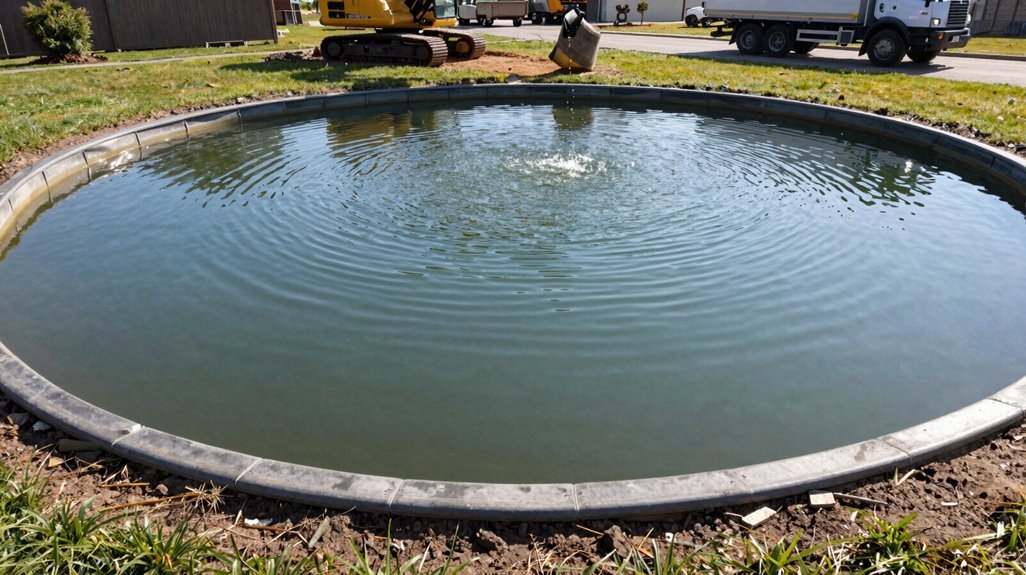
How much deeper does your wallet need to dig beyond the liner itself? I am breaking down the hidden layers that transform your pond liner from rolled material to finished waterscape.
Excavation cost runs $0.10 to $1.20 per square foot, depending on whether I am cutting through pervious topsoil or compacted clay requiring heavy machinery. Underlayment, that essential geotextile barrier preventing punctures from beneath, adds $0.05 to $0.30 per square foot. This is cheap insurance against filtration failures.
Installation labor compounds quickly: general labor at $0.15 to $1.50 per square foot, plus welding or seaming at $0.05 to $0.40 per square foot for those critical hexagon-tiled backdrop seams. Transportation delivers the final blow, ranging from $150 to $2,000+ depending on distance and your stone pillar fountain project’s liner weight.
Estimating Total Cost for Your Farm Pond Liner Project
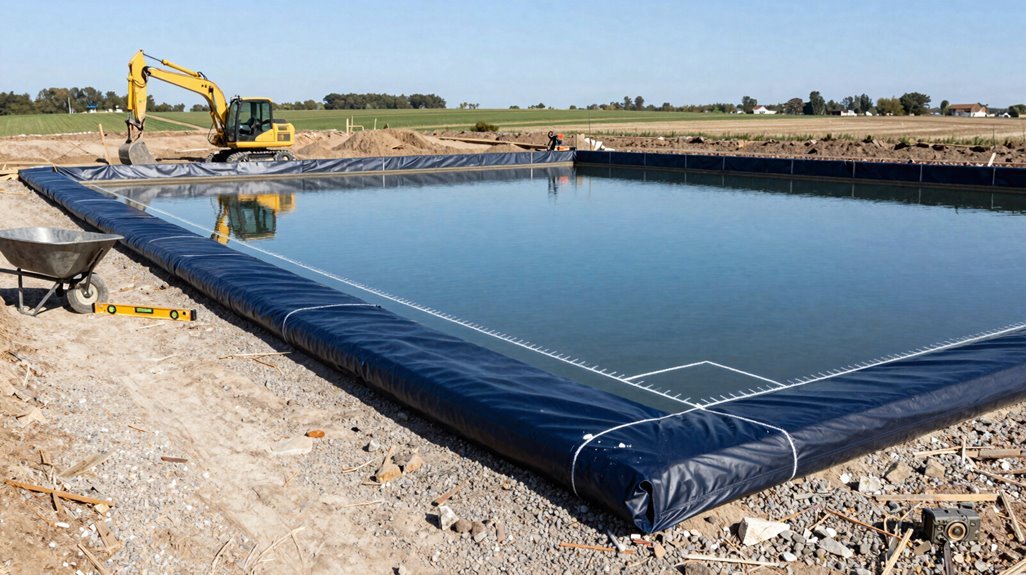
When I’m sizing up a farm pond liner project, I start by mapping every cost layer against my actual acreage and soil conditions. I know pond liner cost swings wildly; material cost per sq ft runs $0.28–$3.00, while my installed cost breakdown hits $0.50–$5.00 per sq ft once I fold in excavation and labor costs.
Pond liner costs swing from $0.28 to $5.00 per sq ft once excavation and labor fold in.
For my 1-acre hexagon-tiled backdrop pond, I’m looking at $20,000–$110,000 installed. I lean toward HDPE liner at $0.35–$1.20 per sq ft for its 40-year lifespan against pervious clay soils.
Material selection includes EPDM, rubber, butyl, PVC, or HDPE for filtration needs. Site prep covers stone pillar fountain placement, grading, and underlayment. Labor intensity involves welding seams, field seaming, and equipment rental. Scale economics show my pond liner calculator results for 50×50 ft versus 1-acre spreads.
I plug my dimensions in, adjust for transportation ($150–$2,000+), and build my realistic budget.