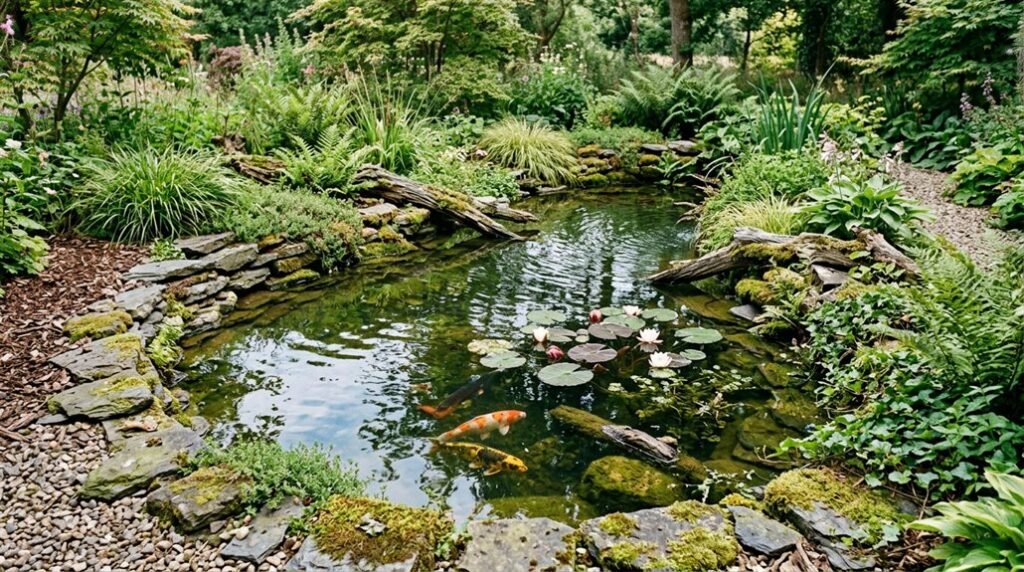
Research indicates that 67% of backyard pond owners rank “unnatural appearance” as their top dissatisfaction, with exposed liner edges ranking first among complaints. I’ve spent years refining methods that transform synthetic barriers into seamless, pervious transitions. The key lies in understanding how water, stone, and root systems interact at the margin.
What follows are five approaches I’ve tested on projects ranging from modest patio pools to quarter-acre water gardens.
Prepare the Liner Edge for Any Concealment Method
Why does every artificial pond I’ve built betray itself at the edges? I’ve learned that proper preparation separates a jarring liner edge from seamless concealment.
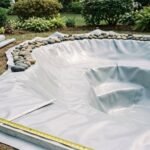
I always leave twelve to eighteen inches of liner overhang, creating a generous tuck-under zone where rocks and soil will eventually hide the synthetic boundary. I build an internal shelf, six to eight inches deep and six to twelve inches wide, which supports perimeter stones while providing essential space to tuck the liner behind them.
Laying the liner smoothly, I drape it into this shelf without large folds or excessive stretching that could tear the material. I position larger rocks first, tucking the liner beneath or behind them, leaving a small vertical flap to prevent water wicking. Finally, I backfill with soil or gravel, stabilizing the edge for natural-looking concealment.
Stack a Rock Shelf to Anchor the Liner
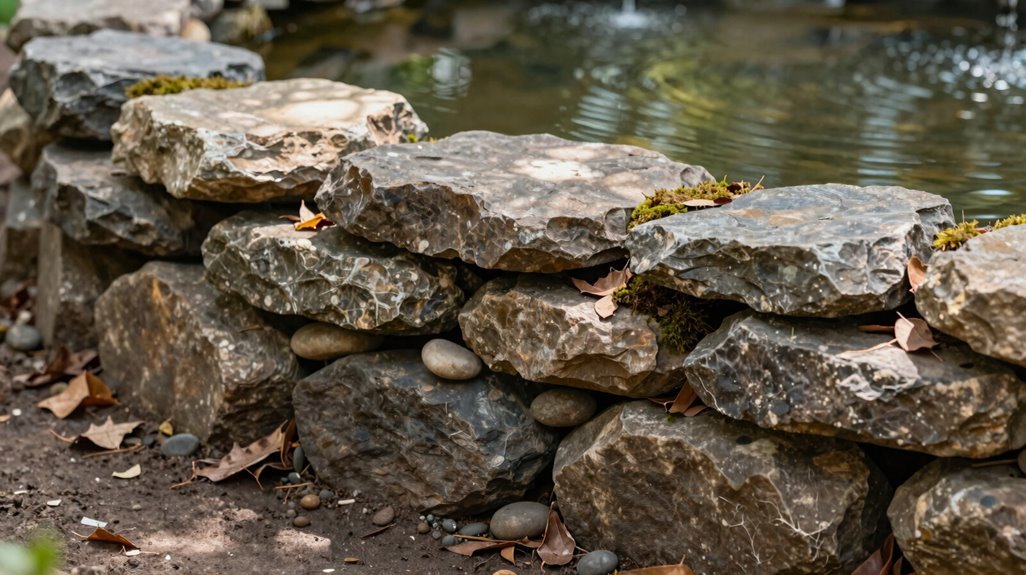
With the liner prepped and that generous overhang in place, I’m ready to build the rock shelf that’ll lock everything into position. I excavate a perimeter ledge, six to eight inches deep and six to twelve inches wide, creating a stable platform for liner concealment.
Starting with substantial boulders, I place them directly on this rock shelf, then fold the liner vertically behind each stone; this small flap prevents capillary action from wicking water outward. Tucking the material underneath as I stack, I achieve seamless edge management that disappears into the surrounding terrain.
| Component | Function | Material Options |
|---|---|---|
| Excavated shelf | Supports rock weight | Native soil, compacted |
| Vertical liner flap | Blocks water migration | EPDM, PVC overhang |
| Backfill medium | Stabilizes perimeter | Gravel, mulch, topsoil |
| Cap stones | Finishes the border | Flat fieldstone, moss |
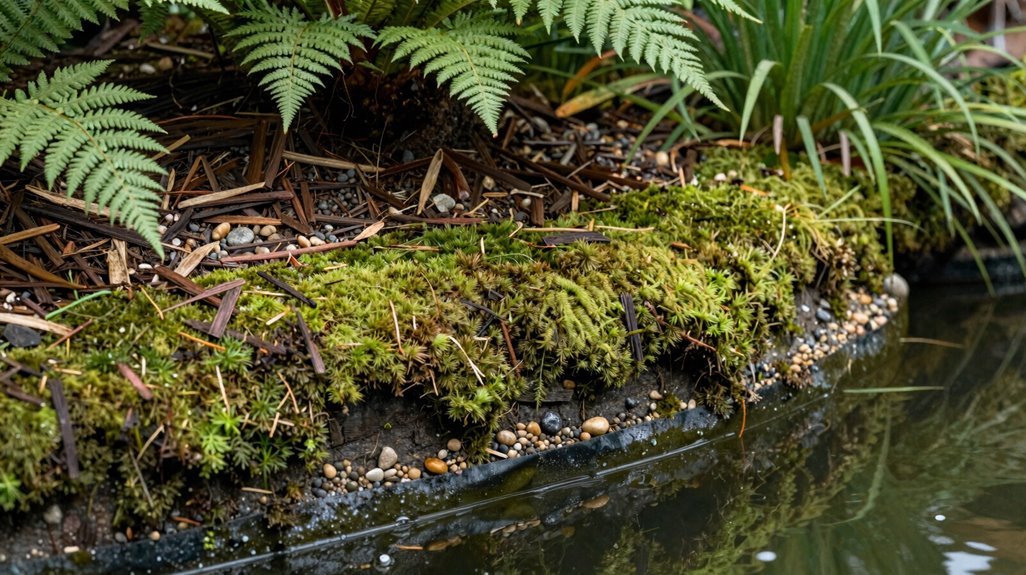
Backfilling with pervious material provides filtration and stability. I trim excess liner to six inches, then crown the assembly with flat cap rocks and creeping groundcovers; this turns artificial boundaries into belonging, where water meets land without visible interruption.
Install Rock-on-a-Roll on Tight Curves
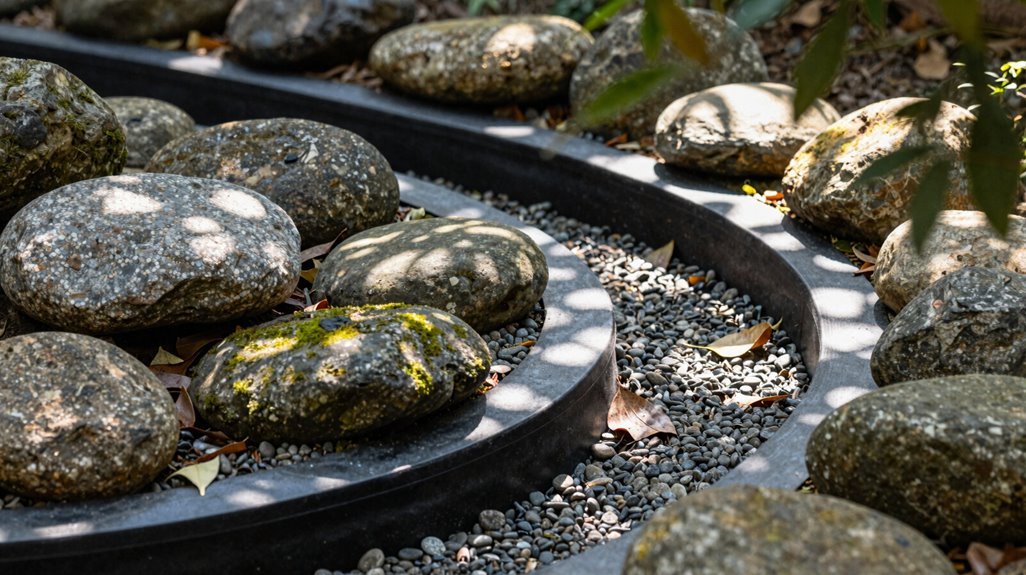
Where curves tighten beyond what stacked stone can gracefully follow, I reach for Rock-on-a-Roll, a pliable rubber mat that drapes and clings where rigid materials fail. Hiding liner along serpentine edges demands flexibility, and this 34-inch-wide rubber sheet conforms to every bend without the burden of heavy rock placement.
I unroll it in Cobblestone or Slate Gray, cutting the lightweight mat with ordinary scissors to trace the pond’s wandering geometry. Each 8-to-40-foot roll, weighing merely five pounds, I position atop the liner, draping the edge and pinning it discreetly with soil or driftwood. No cumbersome stacking, no filtration hoses exposed.
The mat hugs tight curves, masking skimmers and plumbing beneath a textured, stone-mimicking surface that belongs there.
Sink a Gravel Margin That Vanishes Underwater
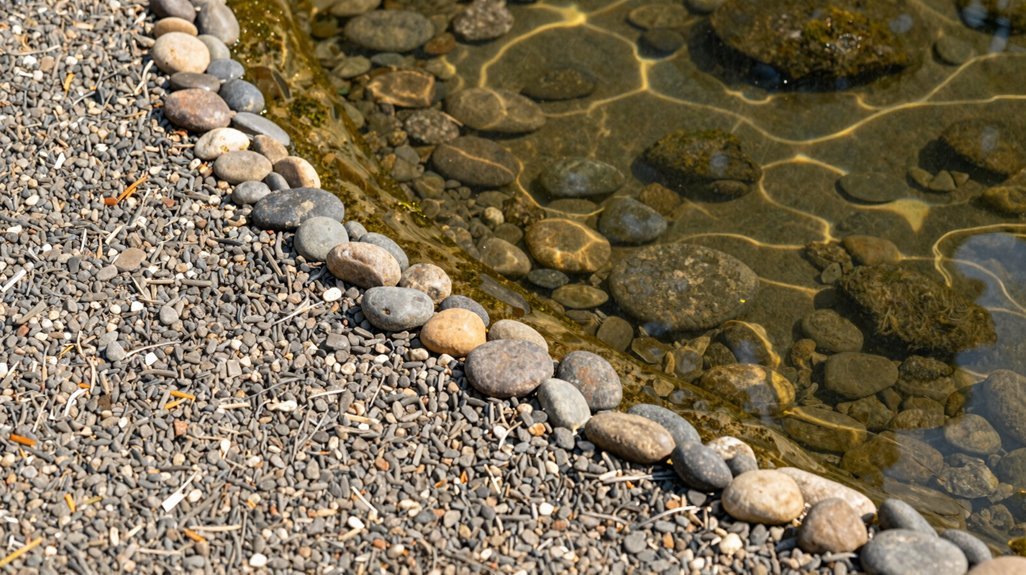
How do you make a pond edge disappear? I sink a gravel margin that vanishes underwater, creating a hidden liner you’ll never detect from shore.
Here’s how this underwater transition changes your pond into something that feels like it belongs there:
- Dig a perimeter shelf two inches below your pond edge, folding the liner onto this deeper ledge
- Blanket that shelf with pea gravel and small cobbles, forming a pervious bed that filters water naturally
- Watch underwater visibility dissolve as the stone bed merges with your pond floor, the hidden liner becoming imperceptible from above
- Maintain gravel depth seasonally, preventing exposure when sediments shift with spring currents
This gravel margin offers safe wading for koi and grandchildren alike. I pair mine with draping marginal plants whose leaves soften the perimeter, completing a filtration system that looks like it grew there.
Layer Plants to Shade and Soften the Edge
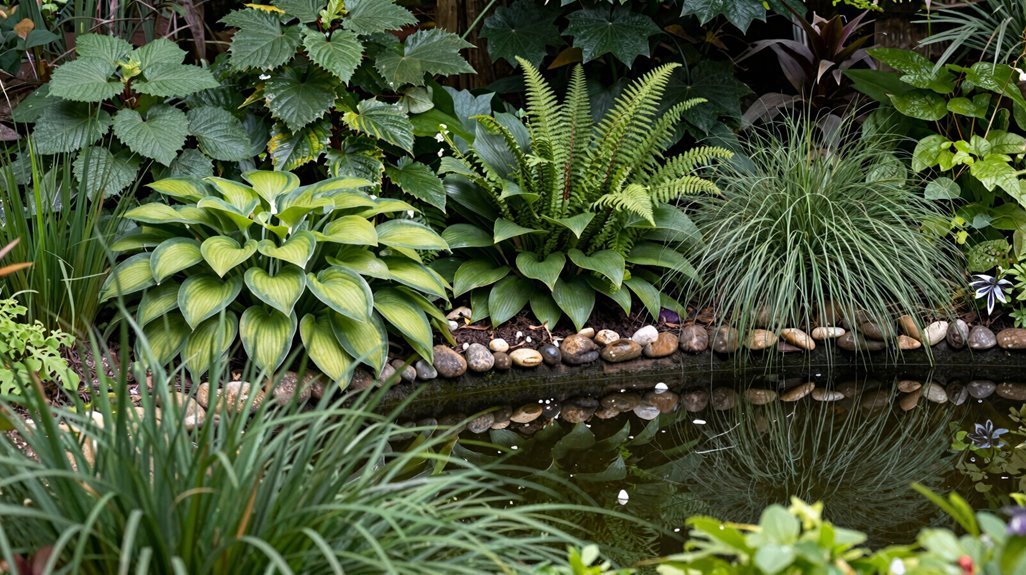
Once the gravel margin settles into place, I turn my attention upward, letting plants finish what stone started. I tuck water iris, creeping jenny, marsh marigold, and cork-screw rush along the inside edging, where their trailing leaves drape over the liner for seamless camouflage. Watching those roots knit together, I see them shade the pervious plastic below while filtering excess nutrients that would otherwise feed algae.
On the marginal shelf, I position spreading specimens to bridge water and soil, erasing any visible seams between worlds. A small solar pump, something like a Poposoap model, circulates gently around establishing stems, preventing stagnation without tangled cords. As seasons pass, these plants thicken into living filtration, softening every edge until the pond breathes like it has always belonged here.