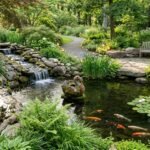

I happened to be installing a stone pillar fountain in my hexagon-tiled backdrop pond when the water turned pea-green overnight. That coincidence taught me something critical: maintaining a small pond isn’t about reacting to crises, it’s about preventing them through precise, layered interventions.
You’ll need to know which step comes first, and why skipping it guarantees failure.
Diagnose and Clear Green Pond Water Fast
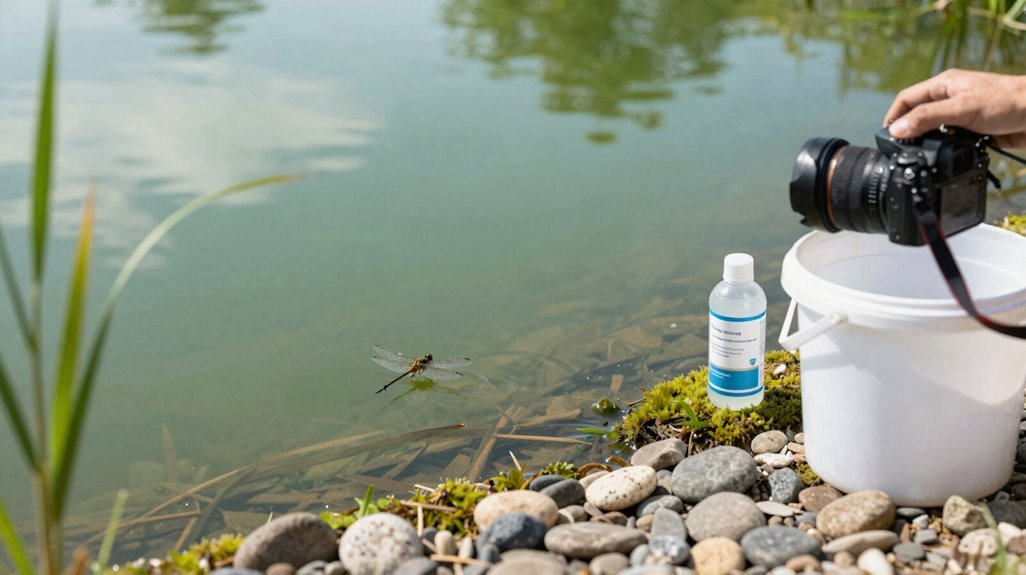
Green water, that pervasive cloudiness that turns your pond into something resembling pea soup, signals an imbalance I’ve learned to read quickly. When my pond water turns that opaque, jade-tinted shade, I’m looking at single-celled algae run rampant.
I tackle this with a UV sterilizer, that cylindrical chamber clamped beside my hexagon-tiled backdrop, where water flows past an ultraviolet bulb. The light ruptures algal cells, clarifying what filtration alone cannot achieve.
Stagnation feeds the problem. I guarantee my pump circulates the entire volume hourly, creating currents that prevent dead zones. Stone pillar fountains add aeration, breaking the surface with visible ripples.
Removing decaying leaves and debris starves blooms of nutrients. I’ve planted floating water lettuce and submerged hornwort, their roots competing with algae while casting shade across the surface.
Don’t Overstock Your Pond With Fish

Clearing the water means little if I’m cramming too many fish into the space I’ve created. I’ve learned that pond fish overstocking occurs when I exceed 10 inches of fish per 100 gallons, a threshold that strains every balanced system I’ve built. Each additional creature compounds waste, turning my hexagon-tiled backdrop murky with ammonia and nitrogen.
I’ve seen how over-population suffocates the stone pillar fountain’s gentle circulation, overwhelming my filtration and starving oxygen reserves. Community wisdom confirms what I’ve experienced: small volumes collapse under excessive biomass. When my tank teeters, I rehome surplus fish to receptive retailers, restoring equilibrium without guilt.
We’re caretakers, not collectors. Respecting capacity preserves the health of every glimmering resident I’ve committed to protect.
Feed Pond Fish Sparingly With Quality Food

Why risk staining my crystal margins with decaying pellets when restraint costs nothing? I feed my fish once daily, scattering only what vanishes in two to three minutes, no more. Floating fish food, drifting like amber coins on the pervious surface, lets me track every bite; sinking varieties slip past my watch, fouling the hexagon-tiled backdrop below.
I choose high-quality blends, dense with nutrition, not fillers that cloud my stone pillar fountain. Sparingly means sparingly: excess nutrients breach my pond’s delicate filtration, inviting algae to colonize what I’ve built. In cooling months, I reduce portions further, matching my fish’s slowing metabolism.
Spotting uneaten flakes, I adjust tomorrow’s measure. This discipline, shared among careful keepers, preserves the clarity we cultivate together.
Cover Half Your Pond Surface With Plants

Half my pond’s surface remains open to sky and wind, the other half given over to lily pads and water hyacinths I’ve learned to curate like a living mosaic. I prune vigorously through spring and summer, dividing aquatic plants to preserve that crucial 50% balance. Without this discipline, my ponds would suffocate beneath their own excess.
| Season | Action Required |
|---|---|
| Spring | Divide and replant established specimens |
| Summer | Cut back excessive floating growth weekly |
| Year-round | Monitor silt accumulation, thin when coverage exceeds target |
I watch for signs: reduced light penetration, diminished oxygen exchange at night when plants respire. Floating mats, once pervious, become impermeable barriers. I remove handfuls of vegetation, maintaining filtration through living roots while preserving open water. This measured approach keeps my ponds vigorous, neither choked nor bare.
Choose the Right Pond Pump for Your Volume
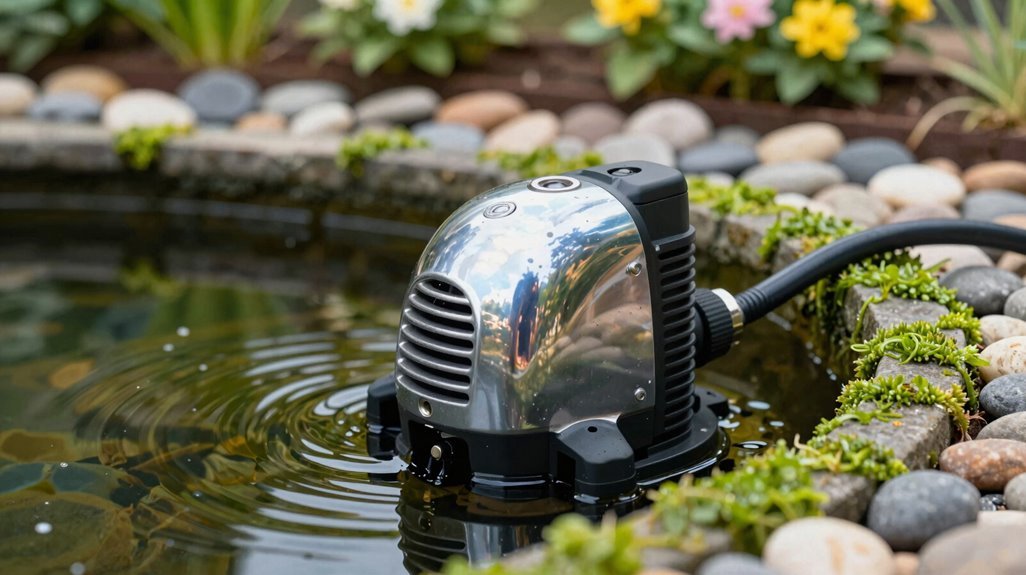
Balancing plant coverage keeps the water breathing, but that living filtration won’t move water on its own. That’s where your pond pump steps in, becoming the heartbeat of this ecosystem we’ve built together.
I choose a pump that circulates my entire pond volume at least once per hour, so that hexagon-tiled backdrop stays crystal clear. Matching the flow rate to my pond size prevents overworking the unit, which I’ve learned the hard way shortens its life. I check regularly that debris doesn’t clog my skimmer, restricting flow and choking efficiency.
For my smaller setup, I evaluated solar-powered options and found they ease maintenance considerably. Some pumps come with built-in filtration, simplifying both mechanical and biological processes. Getting this right means we’re not just pond owners, we’re caretakers of something living.
Skim Pond Debris Before It Decays
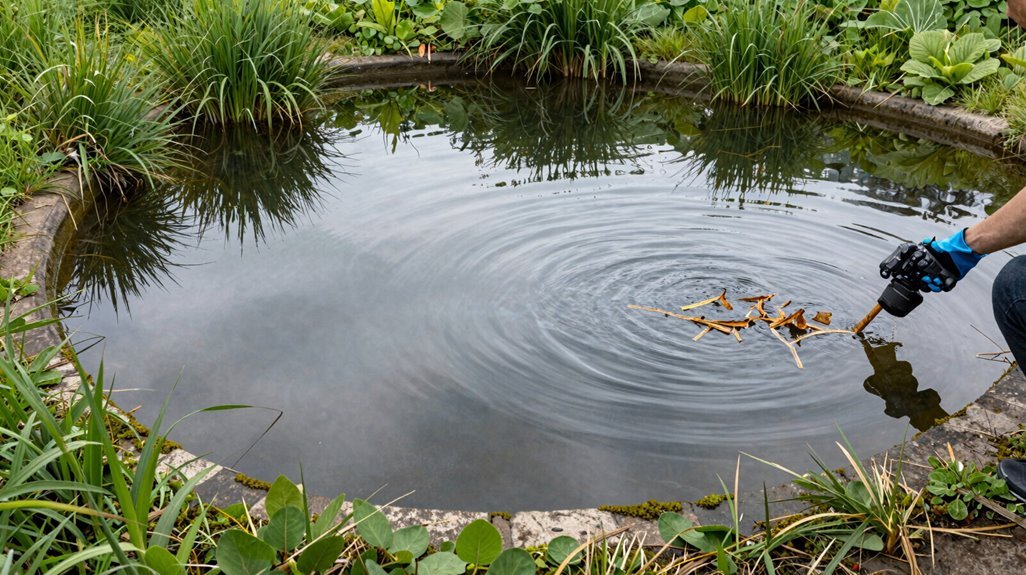
How quickly does a single afternoon of neglect turn my hexagon-tiled backdrop into something murky? I’ve learned that dead leaves, fading petals, and windblown debris don’t just sit there; they decay, releasing nutrients that cloud my pond water and fuel algae blooms. I skim the surface daily with a net, catching matter before it sinks.
I keep roughly half my pond’s surface pervious, free from overhanging plant canopy, so oxygen exchanges freely between water and air. When I spot silt accumulating or growth choking flow, I clean before conditions worsen. Decaying debris steals dissolved oxygen, stressing fish and disrupting the balance I’ve cultivated. This simple habit, repeated consistently, protects the clarity and health of my small ecosystem without demanding complex filtration systems.
Install Pond Filtration That Matches Your Size
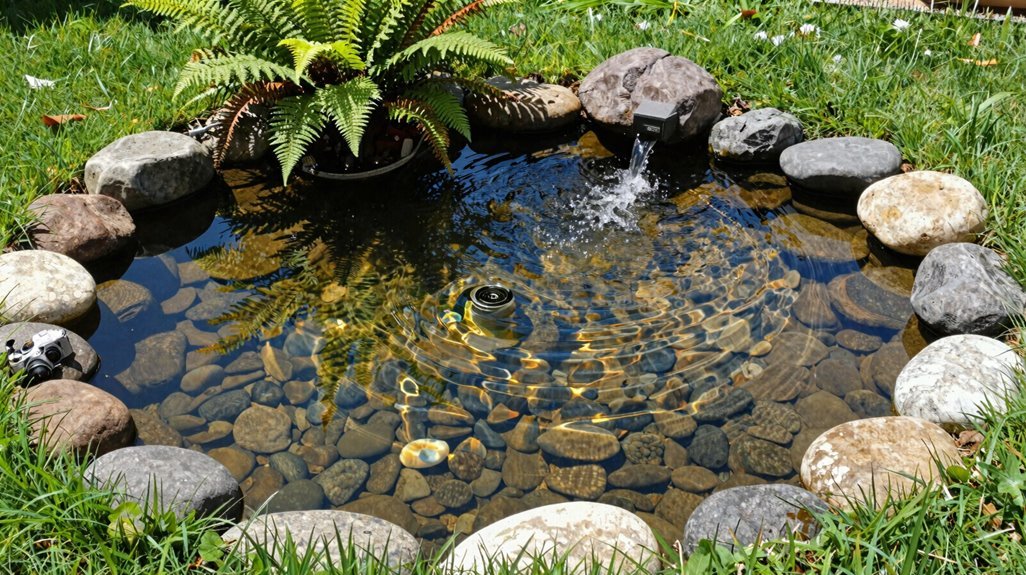
I always start by matching my pump’s flow rate to my pond’s total volume, ensuring it pushes every gallon through filtration at least once each hour. When I’m selecting components, I look for a mechanical skimmer that traps leaves and twigs before they sink, paired with a biological filter, like a cascading biofalls, that houses colonies of beneficial bacteria on its pervious surfaces.
These choices aren’t interchangeable luxuries; they’re the foundation that keeps my hexagon-tiled backdrop and stone pillar fountain from becoming murky, stagnant features I can’t enjoy.
Pump Flow Rates
Why does a pond’s clarity so often betray the hidden struggle beneath its surface? I’ve learned that matching pump flow to your pond water volume keeps that hexagon-tiled backdrop pristine. I circulate my entire volume hourly, checking skimmers weekly for debris that chokes performance. I never push beyond design specs; my stone pillar fountain deserves longevity, not burnout.
| Flow Consideration | Practical Action |
|---|---|
| Turnover rate | Circulate full volume once hourly |
| Debris management | Clear skimmers, verify unrestricted flow |
| System matching | Upsize filtration, combine mechanical and biological stages |
For compact setups, I integrate on-filter options that simplify installation while preserving clarity. We’re building something lasting together: balanced flow, respected limits, and filtration that handles what we cannot see.
Filter Type Matters
Matching pump flow to volume means little if the filter itself can’t handle what passes through it. I always size my filter to match my pond’s water volume, then upsize slightly to manage unexpected waste loads.
Mechanical filters, like skimmers positioned near a stone pillar fountain, capture leaves and surface debris before they sink. Biological filters, such as BioFalls tucked behind a hexagon-tiled backdrop, host beneficial bacteria that break down ammonia and nitrites. I match my pump and filter carefully, making sure complete water turnover happens at least once hourly.
For my smaller pond, I’ve added supplemental filtration to simplify maintenance. Cleaning my filter regularly, per manufacturer guidelines, prevents clogging and preserves efficiency. Choosing the right filter means clearer water, healthier fish, and less work, something every pond keeper wants.
Shade and Aerate Your Pond in Summer Heat

When summer’s relentless heat bears down on my pond, I’ve learned that keeping the water temperature below that critical 75°F threshold becomes my top priority. I’ve watched dissolved oxygen plummet in overheated ponds, so I shade my water’s surface with floating and emergent plants; water lilies, lotus, and pickerelweed creating a living canopy. Covering 40–60% of the surface, these plants compete with algae for nutrients while filtering harsh sunlight.
Come evening, when photosynthesis stalls, I run my aerator through the night. The stone pillar fountain in my hexagon-tiled backdrop churns gently, boosting circulation without destroying that beneficial surface film my fish depend upon. During extreme heat spikes, I monitor closely, adjusting agitation to prevent stress. Together, we keep our ponds breathing.
Block Nutrients at the Pond Edge With Native Plants
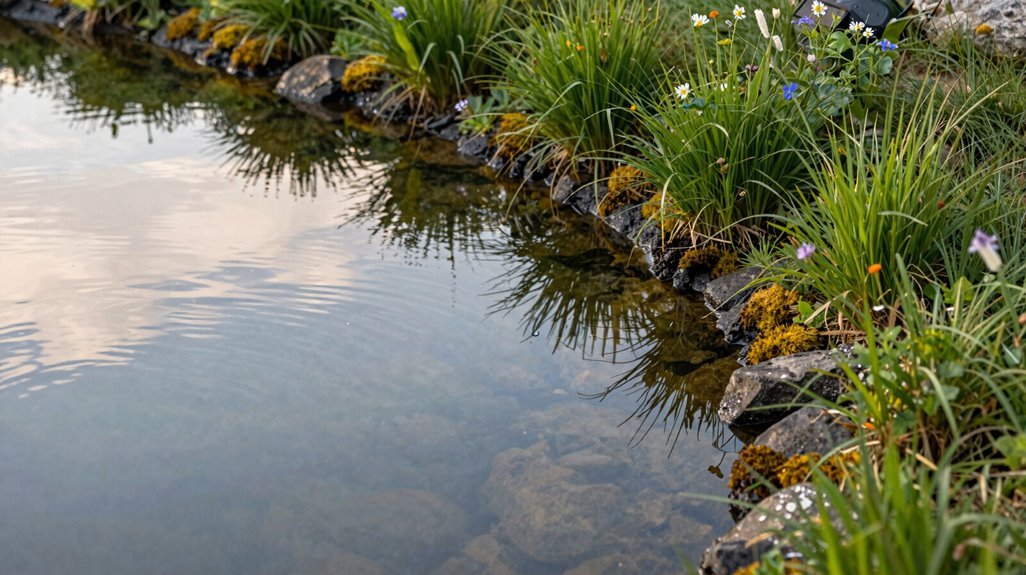
Where do excess nutrients sneak into my pond? I’ve learned they hitchhike in runoff from my lawn, gardens, and any pervious surface nearby. That’s why I plant native vegetation around the edge, creating a living filtration system that catches trouble before it starts.
Dense native plantings—grasses, sedges, and shrubs—absorb phosphorus and nitrogen while their roots stabilize soil against erosion. I mix rooted species with floating natives to maximize uptake across seasons. These plants belong here, evolved for this watershed, doing well without chemical pampering.
| Plant Type | Function | Placement |
|---|---|---|
| Upright grasses | Runoff filtration | Shoreline buffer |
| Floating species | Nutrient uptake | Water’s edge |
| Woody shrubs | Sediment trapping | Slope margins |
| Deep-rooted | Erosion control | Stabilized banks |
Maintaining this buffer means dividing vigorous growth, removing excess before it shades the water excessively; preserving balance, not perfection.
Adjust Your Pond Care for Each Season

I adjust my pond care rhythm as the seasons shift, knowing that spring’s awakening demands new plantings and divided aquatics while winter’s approach calls for protective measures against freezing depths.
Watching my hexagon-tiled backdrop emerge from frost, I’ll add flowering specimens from mid-spring to early summer, feeding them with specialist nutrients when their blooms signal need.
Come autumn’s copper light, I remove fading stems before they sink, preserving the stone pillar fountain’s filtration flow through careful, timely intervention rather than excessive disruption.
Spring Awakening Tasks
How does a pond shake off winter’s dormancy? I begin by assessing water quality, checking for silt accumulation and overgrowth that signals whether cleaning is necessary. I remove dead, crowded growth, aiming to keep roughly half the surface pervious as temperatures rise.
From mid-spring through early summer, I add new plants to establish cover and habitat, while dividing and re-potting oversized deep-water aquatics with floating leaves to maintain balanced growth. Flowering varieties receive specialist food when blooms demand support.
| Task | Timing | Purpose |
|---|---|---|
| Add new plants | Mid-spring to early summer | Establish cover and habitat |
| Divide deep-water aquatics | Spring | Maintain balanced growth |
| Feed flowering plants | As needed | Support healthy blooms |
This filtration of winter debris, combined with strategic planting, restores equilibrium. My pond awakens gradually, hexagon-tiled backdrop gleaming beneath a stone pillar fountain’s gentle cascade.
Winter Protection Measures
When frost begins etching patterns across the water’s surface, I shift my attention toward safeguarding the dormant ecosystem I’ve cultivated. I maintain a small, pervious opening in the ice, using a floating de-icer or aerator, which allows toxic gases to escape and oxygen to penetrate the depths. Monitoring pond temperature becomes essential; I avoid sudden fluctuations that stress my fish, deploying heaters when mercury plummets sharply.
I remove decaying lily pads and submerged foliage, preventing nutrient overload that fuels spring algae blooms. I shade a portion of the surface, limiting light penetration while preserving habitat for surviving organisms. I taper feeding schedules, then stop entirely as metabolism slows, minimizing ammonia accumulation beneath the hexagon-tiled backdrop of frozen stone. These measured steps protect our shared sanctuary through winter’s dormancy.