I’ve walked past too many fountains where the water merely sputtered, the nozzle choice betraying the architect’s vision. Selecting the right nozzle, whether you need a laminar stream slicing through LED light or an aerated plume braving coastal wind, shapes every ripple, every shadow on your hexagon-tiled backdrop. Your stone pillar fountain deserves better than guesswork.
I’ll show you ten nozzles, each with distinct flow demands and wind thresholds, so you stop wasting water on mismatched equipment. Let’s start with the one specification that determines whether your display becomes translucent glass or chaotic spray.
Why Your Fountain Nozzle Choice Determines Project Success
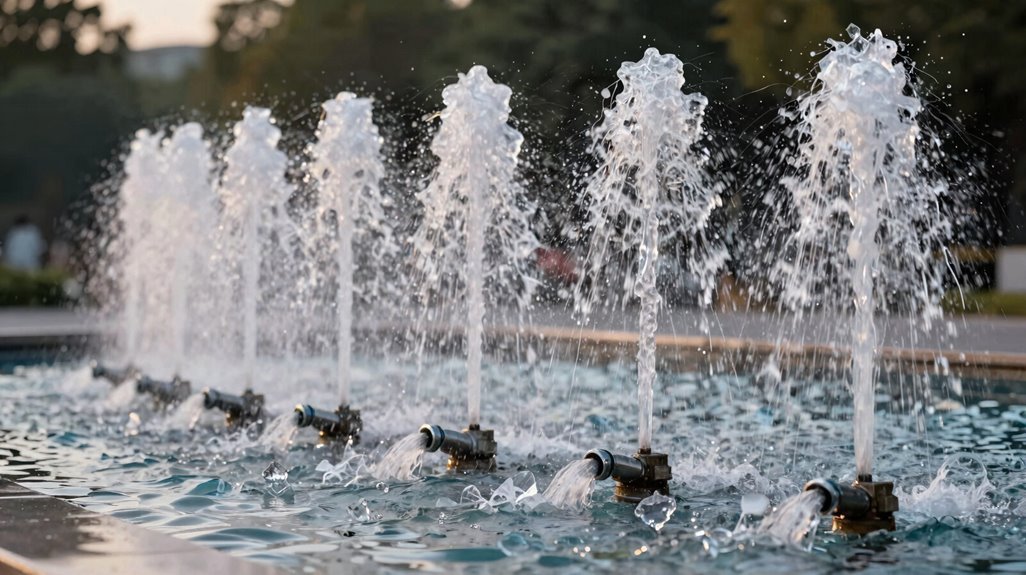
How often do we overlook the nozzle when planning a fountain, only to watch our vision fall flat against the wind? I’ve learned that fountain nozzles aren’t mere accessories, they’re the heart of every successful installation.
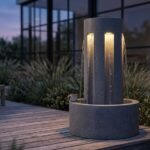
Choosing the right nozzle directly shapes your display’s height, wind resistance, and spray pattern. I’ve seen stone pillar fountains transform when matched with proper hardware, their water catching amber light against hexagon-tiled backdrops.
Laminar nozzles create those glass-like streams we crave for nighttime illumination, though they’re pervious to gusts without sheltered placement. Aerated, mushroom, and geyser designs deliver bolder plumes, each demanding specific pump capacity, filtration, and lighting integration.
Performance-based specifications protect your design intent, allowing qualified substitutions without sacrificing vision. Multi-nozzle configurations, sheet water, weirs, combined jets, build layered drama. Together, we’ll master these choices, crafting fountains that belong in their spaces.
How to Choose: Flow, Pressure, Wind, and Pump Matching
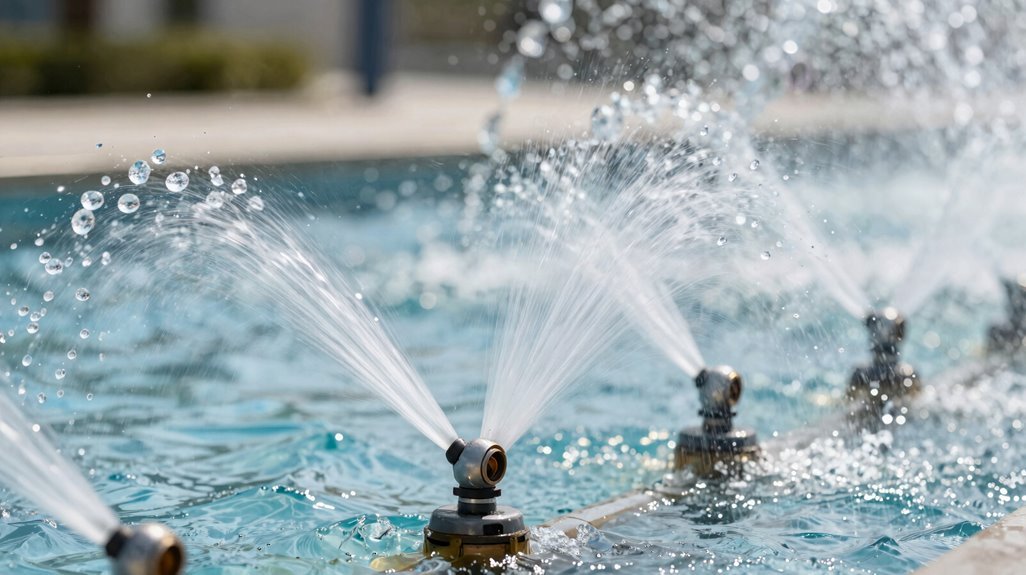
Where do we begin when the nozzle catalog sprawls before us, each specification promising transformation? I start by matching water flow to the display height I envision, making sure the nozzle’s flow rate and operating pressure align with my pump’s capabilities.
Wind exposure shapes my choice: laminar or fine-spray nozzles suit sheltered courtyards with hexagon-tiled backdrops, while aerated or geyser nozzles demand higher pressure and careful wind management. Checking that the pump matches the nozzle’s needs is critical; geysers need more headroom than laminar jets.
I consider compatibility with existing hydraulics and nighttime lighting, avoiding excessive evaporation or splash against my stone pillar fountain. For multi-nozzle configurations, I coordinate design to prevent conflicting flows, achieving layered effects without overloading the system.
Spray Cloud Nozzles: From Fine Mist to Dramatic Water Clouds
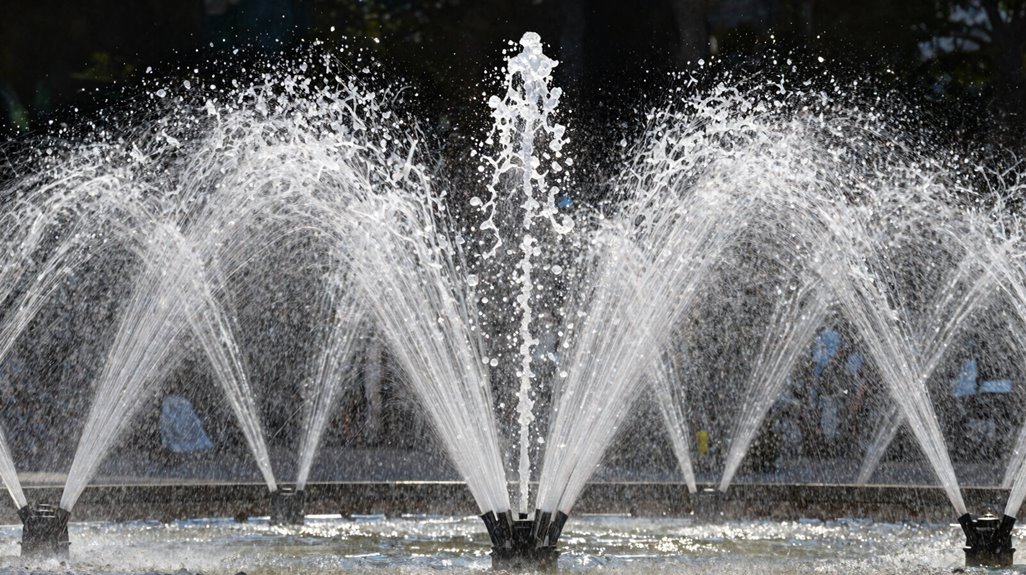
Considering spray cloud nozzles, I’m struck by how these components transform a simple stone pillar fountain into an atmosphere-shaping element, their pervious mist catching light above hexagon-tiled backdrops while denser configurations envelop viewers in immersive vapor. Architects specify stainless steel tank assemblies and precision-patterned heads, knowing that filtration and pressure calibration determine whether a jet resolves into micronized haze or billows upward as a dramatic, room-filling cloud.
I’ll guide you through matching these ranges to your fountain’s spatial constraints and visual intent, because effective integration demands more than aesthetic preference; it requires understanding how cloud density, spray height, and pattern geometry interact with wind exposure and sightlines.
Spray Cloud Range
Why settle for ordinary water effects when you can fill a plaza with drifting, luminous vapor? I’ll show you how the Spray Cloud Range changes spaces through precision engineering. The LI-4060 to 4061 nozzles let me sculpt everything from micronized mist to massive, billowing clouds. I group stainless steel tanks with specialized spray nozzles, making certain each water cloud carries exact density and texture. Adjusting height, distribution, and droplet size, I match atmospheric conditions and lighting demands without compromise.
Walking through cooling mist that catches sunset hues, you feel instantly transported. Watching children vanish into shimmering fog, you remember wonder itself. Standing together beneath glowing vapor, you share something unspoken with strangers.
Selecting proper spray cloud nozzles means balancing pervious filtration against wind resistance, achieving effects that invite everyone inward.
Architectural Integration
How do you weave vapor into stone and steel so completely that the architecture itself seems to breathe? I start by selecting spray cloud nozzles that transform water into misty pervious layers, their micronization drifting against hexagon-tiled backdrops like filtered light through gauze.
These systems, grouped through stainless steel tanks, carve precise water shapes around stone pillar fountains, their density calibrated to complement surrounding materials. Customizing cloud volume, height, and filtration levels, I tailor each installation to its context: dramatic plumes rising beside glass facades, gentle haze settling into limestone courtyards.
The precision guarantees consistent color and motion, lighting catching droplets in suspended animation. Your structure doesn’t merely host water; the spray cloud nozzles make architecture inhale, exhale, belong to the sky it mirrors.
Vertical and Adjustable Jets: Precision Streams You Control
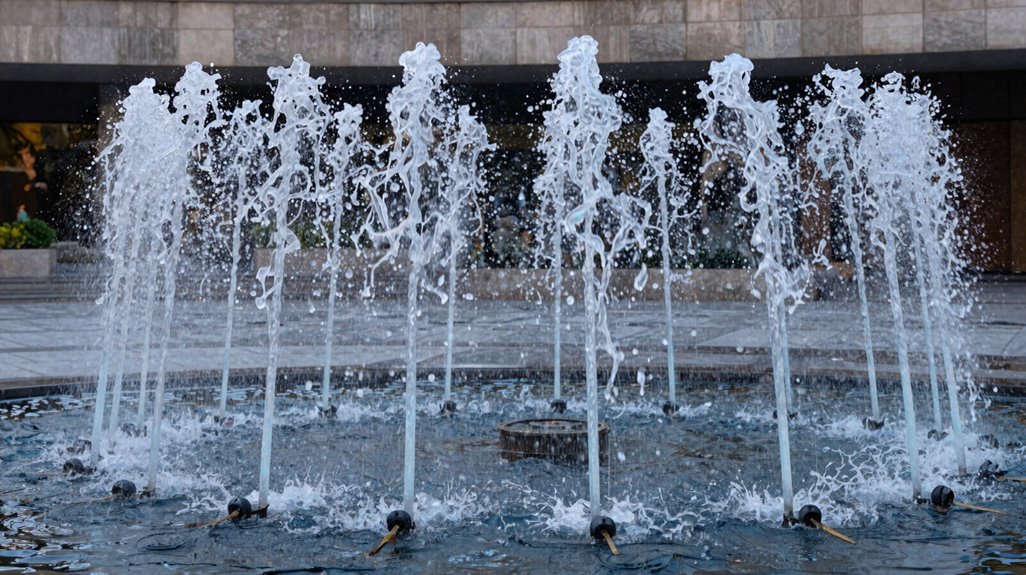
Controlling water’s ascent with surgical precision, I will guide you through adjustable spray patterns that change a stone pillar fountain from a gentle burble into a spear of crystalline intention. The LI-Q5011 through Q5019 brass series offers pervious calibration, letting you modulate flow rates until the stream matches your filtration system’s capacity and your eye’s demand.
For those seeking the glass-bell purity of crystalline water veins, the LI-5050 through 5079 vertical jets deliver that hexagon-tiled backdrop shimmer without the murmur of aerated chaos.
Adjustable Spray Patterns
Where exactly do you want your water to go? I ask because adjustable jets let me sculpt every stream to my exact vision, turning raw hydraulic pressure into deliberate art.
My brass adjustable jets, the LI-Q5011 through Q5019 series, offer dimensions and flow rates I can fine-tune for direction and intensity. I’m not guessing; I’m commanding each droplet’s path across my hexagon-tiled backdrop or stone pillar fountain.
Crafting your perfect arc, you finally feel heard in a world of mass-produced features. Tuning each pulsation, you belong among designers who refuse generic solutions. Shaping impervious spray angles, you claim your space with precision others notice.
I don’t settle for pervious, uncontrolled displays. With proper filtration maintaining my adjustable jets, I achieve technical mastery without sacrificing creative warmth.
Crystalline Water Veins
Adjusting the arc is one thing, but now I’m raising the stakes upward. Crystalline water veins demand vertical precision, and I’ve found the LI-5050 to 5079 series delivers that glass-thread quality you’re after.
For monumental displays, I’m specifying stainless steel LI-5080 variants, their pervious engineering standing tall against weather and time. When I need multi-dimensional command, brass adjustable jets LI-Q5011 to Q5019 let me sculpt flow and direction simultaneously, narrowing streams against a hexagon-tiled backdrop. Bronze waterfall nozzles LI-Q5103 to Q5106 layer cascading sheets at accessible points, completing the vertical vocabulary.
Stainless steel and brass both answer to pressure management, giving me crisp, narrow columns with controlled reach. Whether piercing sky above a stone pillar fountain or threading through filtration systems, these jets belong in precision-driven designs.
Cascade and Waterfall Nozzles: Flowing Ribbons and Sheets
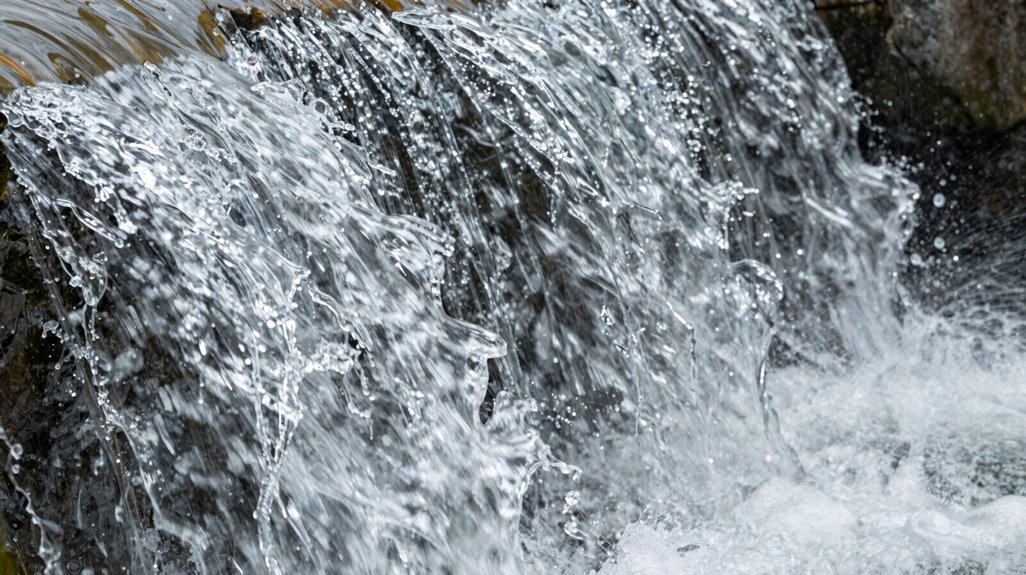
How does water transform into something almost architectural, a suspended curtain you could nearly walk through? I find the answer in cascade nozzles, which shape flowing ribbons and sheets into continuous, edge-to-edge water surfaces. These nozzles create the large-format waterfalls that define luxurious hotel displays, drawing us into spaces where water becomes a shared, immersive boundary.
Picture standing before a hexagon-tiled backdrop, the cascade’s steady murmur inviting you closer, into the collective hush of strangers united by wonder. Picture evening light catching aeration elements, each bubble a small triumph of engineering, brightening the plume so we all witness the same fleeting brilliance. Consider the stone pillar fountain in your city’s plaza, its layered cascade display offering a place where belonging feels as natural as breathing.
Selecting these systems demands balancing flow rate, pump pressure, wind exposure, and filtration against each site’s unique demands, so that pervious, reliable structures—like stainless steel cascade jets—maintain their shape through changing conditions.
Aerated and Bubbler Nozzles: Foamy, Light-Absorbing Displays
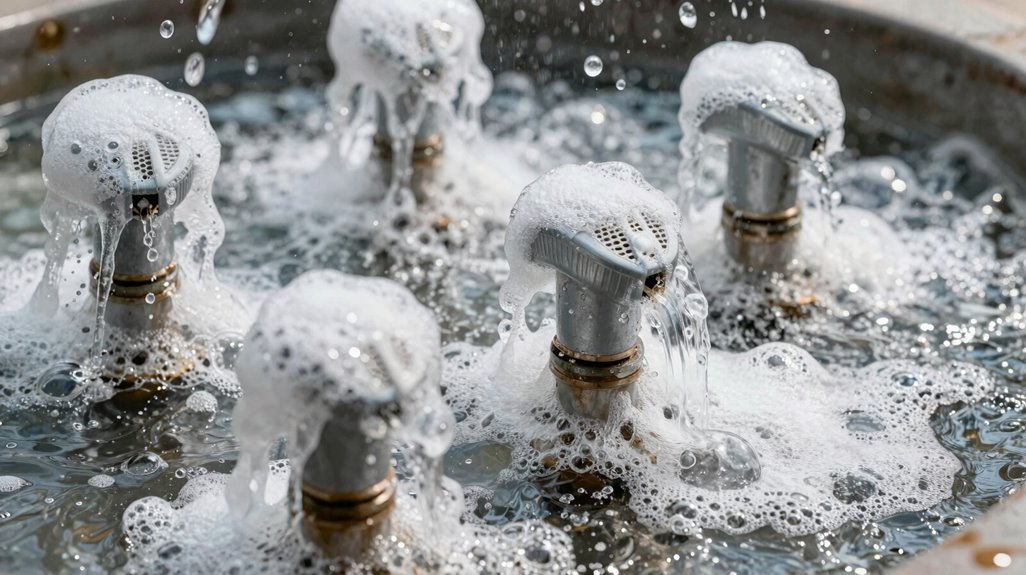
Looking at aerated nozzles, I’m struck by how their air intake mechanisms pull atmospheric oxygen directly into the water column, transforming a clear jet into a pervious, foam-filled plume that catches light like a hexagon-tiled backdrop catching sunset. This foam texture isn’t merely decorative; it creates a light-absorbing, almost stone pillar fountain solidity that remains visible from hundreds of feet away, even under harsh midday sun.
Understanding these mechanisms matters because the filtration and hydraulic precision behind them determine whether your display maintains that billowing, mushroom-capped consistency or collapses into a wind-whipped mist.
Air Intake Mechanisms
Where exactly does that billowing, luminous quality come from when you’re watching a fountain’s plume catch the evening light? I’m drawn to how aerated nozzles pull air through dedicated intake pipes or optional side holes, mixing it with pressurized water to create those opaque, cloud-like mounds we gather around. You’re seeing physics at work: air bubbles trapped in the stream scatter light, making the plume pervious to illumination yet visually substantial against a hexagon-tiled backdrop.
Geyser-style variants demand higher pump capacity, delivering vertical jets that command attention near any stone pillar fountain, though wind can disrupt their symmetry. I keep filtration systems clean because foam stability depends on hydraulic balance; without it, the effect collapses into flat, ordinary spray.
- That hush of collective wonder when evening lights first hit the foam
- Children reaching toward mist that feels almost solid enough to hold
- The shared pause between strangers, united by rising water
Foam Texture Benefits
Shifting from how air enters the stream, I’m now considering what that aeration actually gives us once the water leaves the nozzle. Aerated nozzles transform water into foamy, opaque white mounds that absorb light beautifully, creating dramatic visibility day and night against hexagon-tiled backdrops or stone pillar fountains.
You’ll notice these foam displays resist wind better than solid laminar streams, maintaining consistency in exposed outdoor installations. The texture produces a gentle, cheerful sound that you can tune by adjusting flow rate and air intake for desired fullness. Reaching that perfect pervious quality demands high-quality filtration, though. Without it, foam irregularities disrupt the uniform morphology you’re after.
Ultimately, these light-diffusing plumes reward viewers from every angle with radiant, approachable effects that invite lingering observation.
Laminar Flow Nozzles: Glass-Rod Effects and Wind Limitations
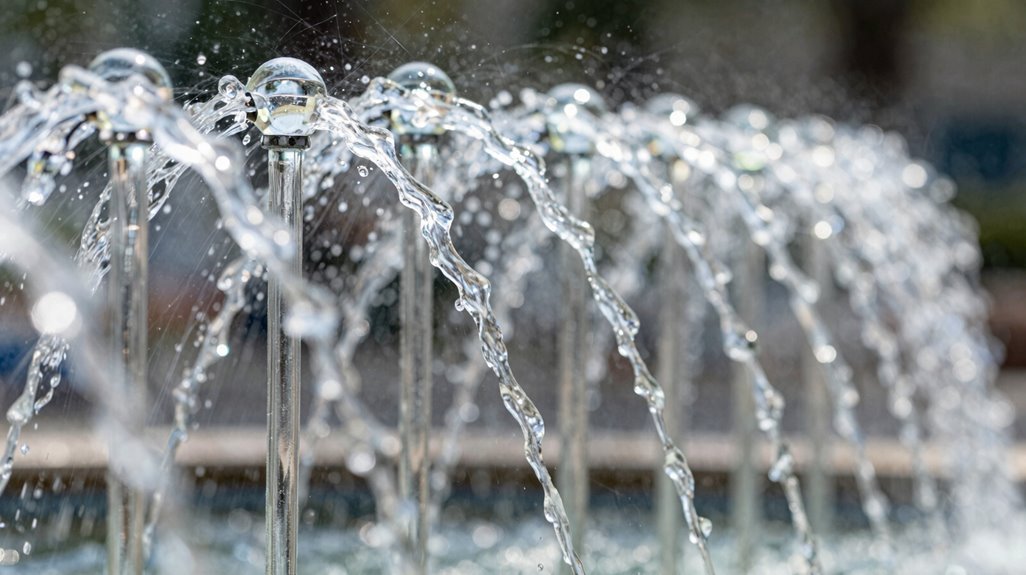
Picture a stream of water so glassy and still it could pass for a solid crystal rod, that’s the signature effect laminar flow nozzles deliver. I’ll break down exactly how they pull it off. Inside each nozzle, a honeycomb flow straightener strips away turbulence, shaping pervious liquid into a transparent cylinder that holds its form across long distances. Paired with integrated LED lighting, that hexagon-tiled backdrop becomes something almost unreal at night.
- Feeling that hush fall over a plaza when the jet appears motionless, frozen in time.
- Sharing a breath with strangers as light pierces the column’s core together.
- Knowing you’ve found the one fountain detail that makes a stone pillar fountain memorable.
Yet wind remains the enemy here. One gust shatters the illusion, breaking that glass-rod clarity into chaos. Shelter your laminar flow nozzles, and they’ll reward you with precision few other nozzles match.
Multi-Jet and Column Nozzles: Towers, Palms, and Radial Bursts
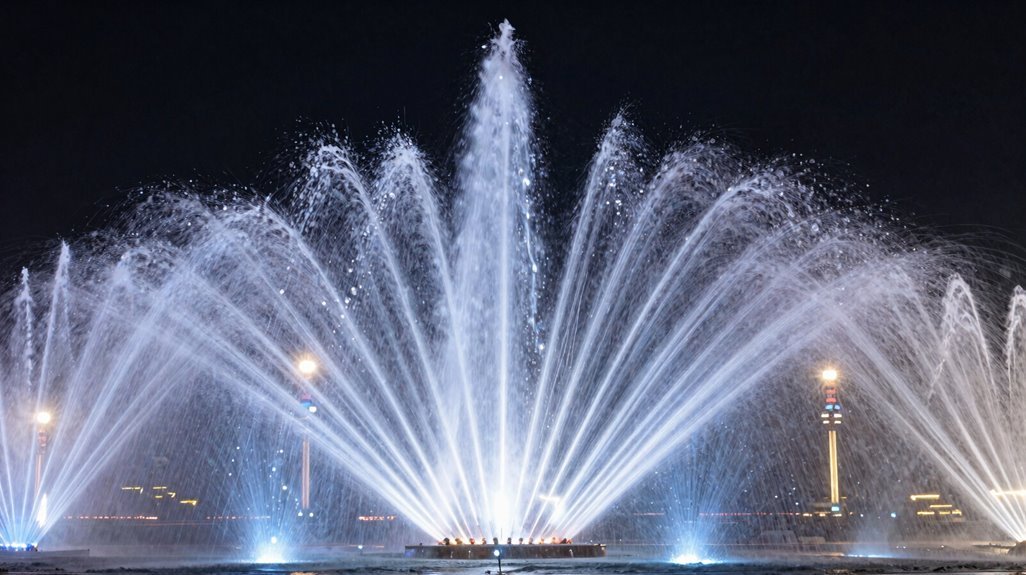
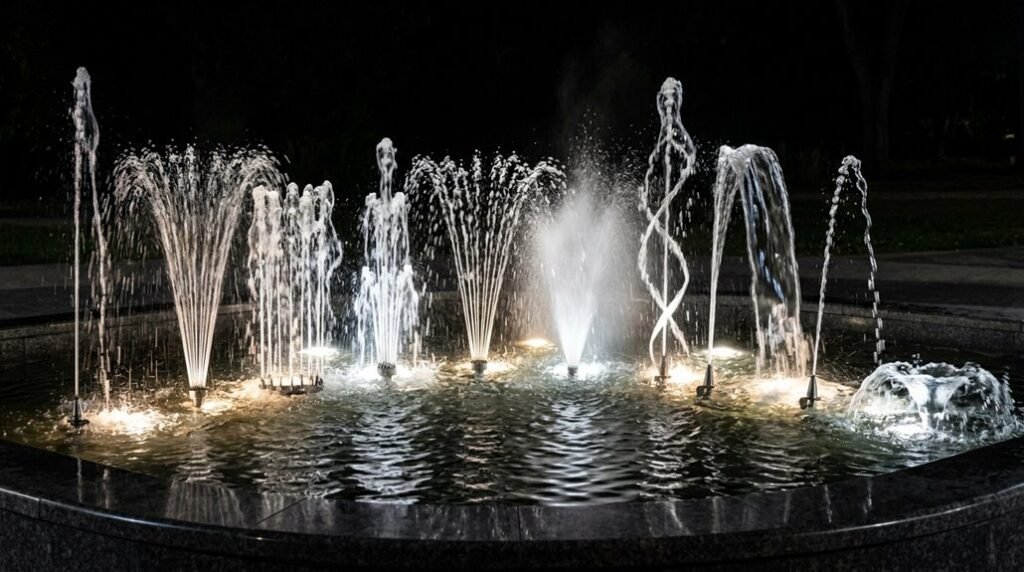
How does a single column of water become a tower, a palm frond, or a starburst frozen in motion? I use multi-jet and column nozzles, which transform previous streams into architectural statements.
Column jet nozzles, like the LI-5502 series, shoot tall, slender pillars perfect for vertical emphasis against a hexagon-tiled backdrop. Brass and bronze column spouts, including the LI-Q5511 variants, balance cost-efficient filtration with refined aesthetics along stone pillar fountains.
Multijet nozzle systems cluster smaller jets into radial bursts, layering complex effects around focal points. Arranged precisely, these nozzles evoke palm-tree canopies or tower spirals. I choose them for reliable maintenance, precise flow control, and seamless integration into large-scale installations.
Whether designing a courtyard centerpiece or plaza landmark, I rely on their disciplined engineering to deliver belonging through shared spectacle.
Hemisphere and Sphere Nozzles: Centerpiece Effects for Ponds
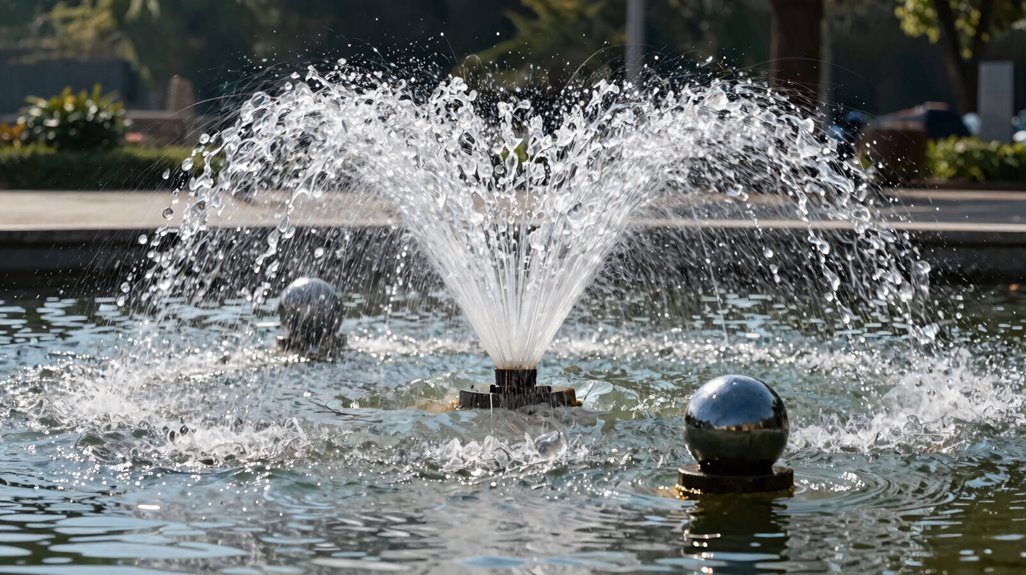
Moving away from vertical columns and radial bursts, I turn toward shapes that enclose space rather than pierce it. Hemisphere and sphere nozzles invite you into a shared visual experience, crafting rounded, immersive water forms that anchor the entire pond display.
These configurations generate globe-like spray patterns, branching into surrounding jets with satisfying symmetry. I’ve seen them change stone pillar fountain settings into gathering places, their ball-shaped formations visible from every angle around the water’s edge. Stainless steel and brass variants withstand outdoor exposure, maintaining consistent surface finish through seasons of filtration and flow.
Feeling the cool mist against your skin as you join others at the pond’s edge; watching lamplight catch the water’s curve, creating a luminous sphere we all share; discovering your reflection suspended inside the cascading hemisphere.
Paired with deliberate lighting and pervious wind planning, these nozzles cultivate serene, gallery-like atmospheres where we belong together.
Projection and Specialty Nozzles: Video Screens and Digital Curtains
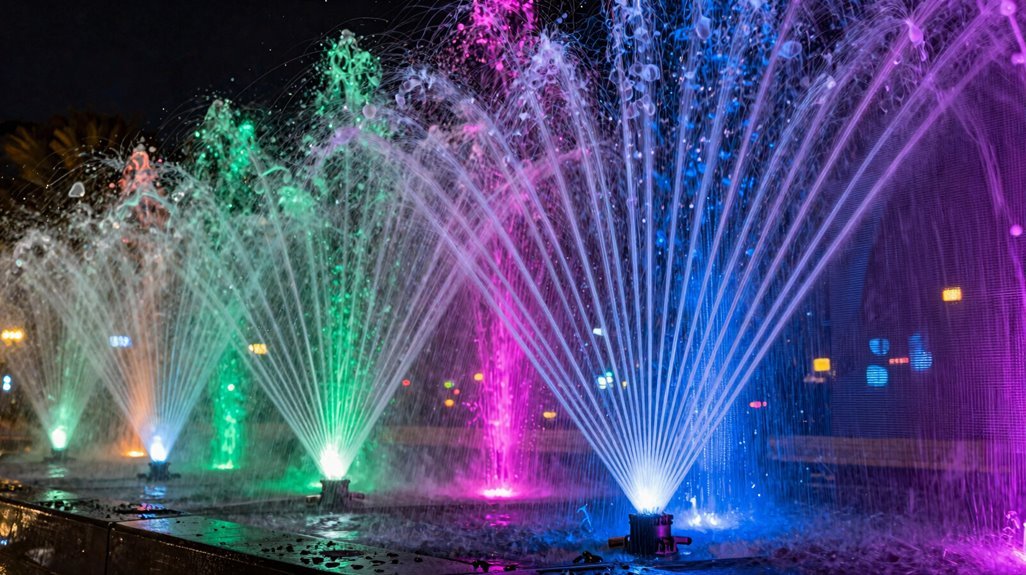
Where else but on water can you paint with light itself? I rely on a water screen nozzle like the LI-6000 when I need vast projection surfaces for video or laser displays, its hydraulic precision catching pixels mid-air against wind-darkened sky. For digital curtains, I specify rain nozzles, the LI-6121 series, with fixed or programmable patterns, weaving falling water into hexagon-tiled backdrops of shifting transparency.
These systems demand paired high-flow pumps, VFD control maintaining screen height and razor edge definition. I select stainless steel for every wetted part, resisting corrosion, thermal cycling, and the ozone crackle of arc lamps. Clarity falters without compatible lighting integration; I balance lumens against lumenance, nozzle velocity against ambient breeze. Projection on water joins our shared spectacle; nothing equals its pervious, dissolving screen.