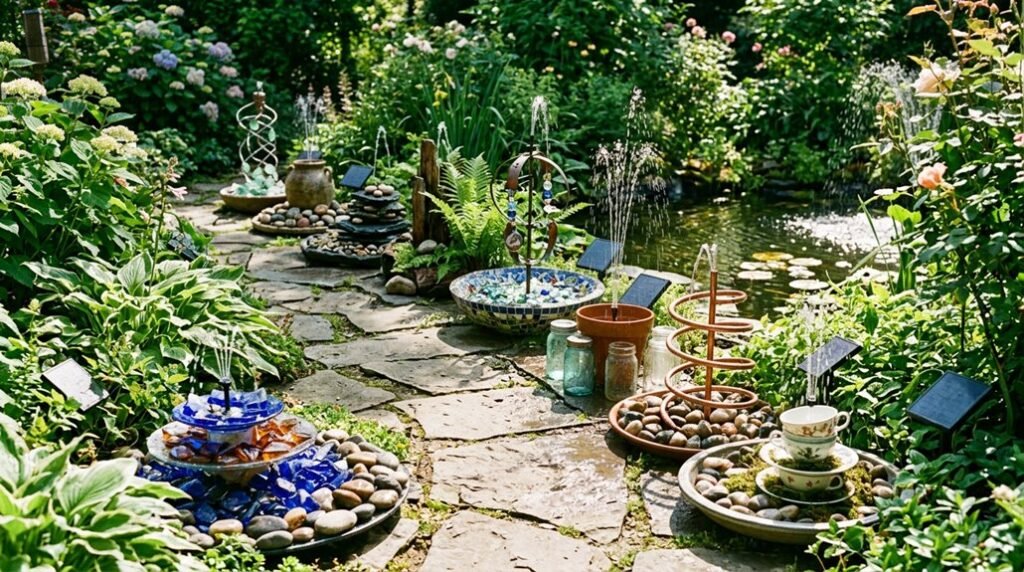
You don’t need plumbing skills or expensive equipment to build a working water feature. I’ve assembled ten solar-powered fountains, from a galvanized tub with a 1.5W pump to a terracotta pot bubbler concealed beneath pea gravel, and each project relies on pervious rock filtration and specific plantings like Baby Tut papyrus to maintain clarity.
The real challenge isn’t construction; it’s selecting components that won’t fail when sunlight fluctuates. I’ll show you which pumps survive partial shade, how to anchor floating ceramics against wind, and why water lettuce outperforms chemical treatments for algae control.
Build a One-Hour Galvanized Tub Solar Fountain

A galvanized tub fountain offers an entry point into solar-powered water features that I find practical for most gardeners. For this DIY garden fountain, you’ll need a 25-inch Behrens tub or similar vessel, plus a 1.5W solar fountain pump with its 10-foot cord.
Here’s my one-hour setup method: I plug drainage holes in nursery containers, fill them with soil and aquatic plants; Baby Tut papyrus, taro, or Siberian iris work beautifully. Topping with pea gravel and river rocks prevents floating debris, creating natural filtration. Water lettuce further cleans the basin.
I position the panel in sun, though I shade it during adjustments to protect the pump. Half-filling the galvanized tub suffices. Running your sun-powered water feature, you’ll hear the quiet hush of water through stone; a simple, functional addition to any garden we might share.
Turn a Terracotta Pot Into a Solar Bubbler
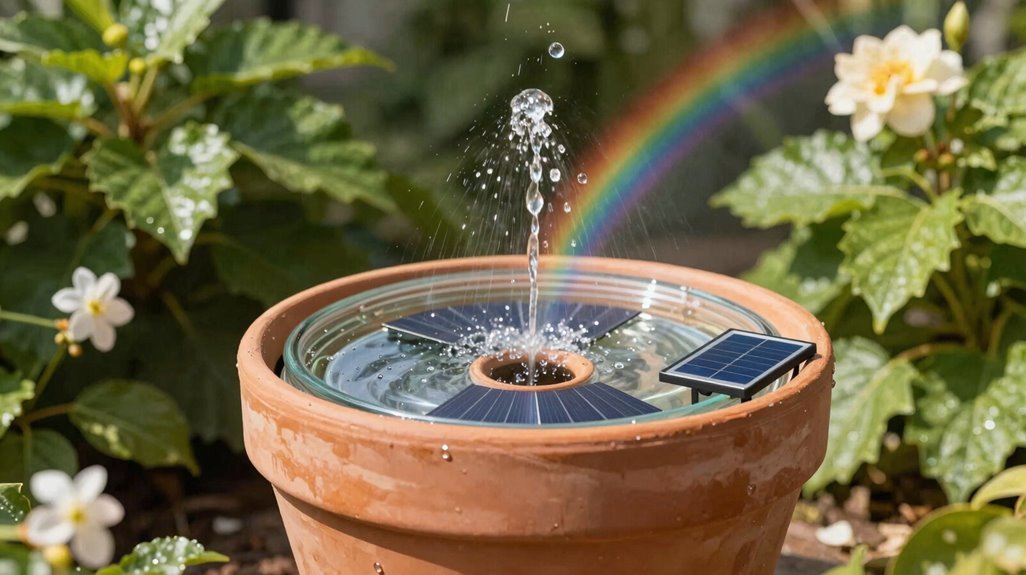
Three stacked terracotta saucers, their rims weathered to dusty rose, form the reservoir I’ve tucked inside a cracked garden pot I’m repurposing. This DIY garden water feature turns imperfection into quiet function, the pervious clay now sealed against erosion with waterproof liner.
Nestle a deep plastic saucer inside the terracotta pot, creating a hidden basin for your sun-powered fountain. Position the corded solar panel in full exposure, routing it discreetly beneath pea gravel. Submerge the fountain pump, with water reaching halfway to prevent dry-running the filtration system. Crown the assembly with river rocks, stabilizing the solar bubbler while masking technical elements.
The result: a stone pillar fountain’s humble cousin, hexagon-tiled backdrop optional, murmuring to those who linger.
Make a Floating Fountain in a Ceramic Birdbath
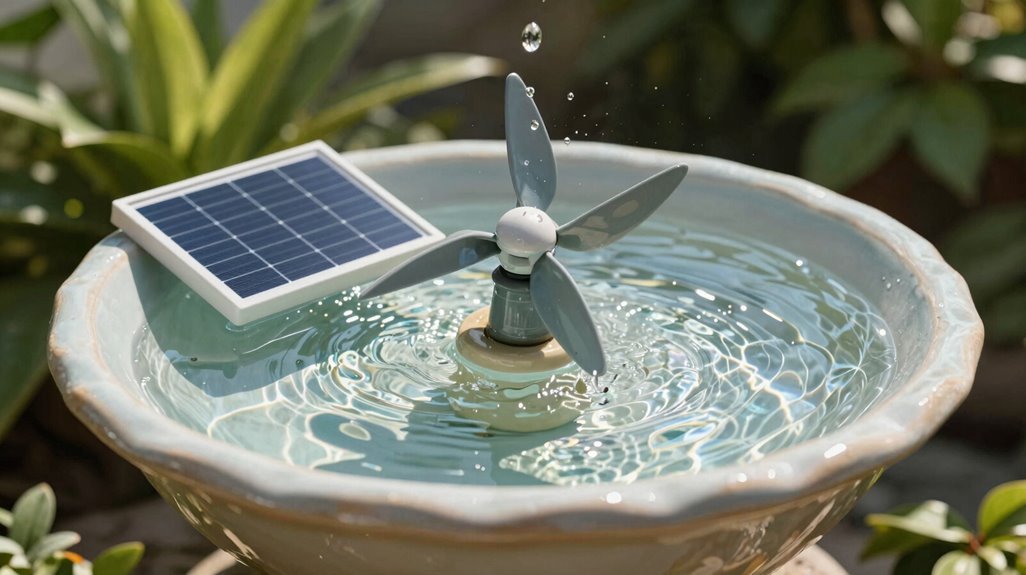
Where else can you find such simple serenity than in a ceramic basin, its glazed rim catching morning light, where I once set a palm-sized solar disc to drift like a lotus upon still water? This water feature demands no plumbing, no buried cables, only sunlight and a watertight vessel.
I chose a low-profile floating pump with interchangeable nozzles, its separate solar panel positioned several feet distant to prevent splash interference and overheating. The ceramic birdbath, glazed in deep cobalt, holds enough pervious depth to submerge the fountain head completely.
When clouds pass, my kit’s battery backup maintains the gentle burble. Position your panel south-facing, keep filtration simple, and you’ll share this quiet corner with visiting sparrows who come to bathe in the hexagon-tiled backdrop of your making.
Combine Flowers and Water: Solar Planter Fountain

Nestled within weathered galvanized steel, my terracotta planter fountain brings together two garden pleasures I’ve always kept separate: the soft crush of petals and the liquid murmur of moving water. This flowers and water combination feels like discovering something I didn’t know was missing.
Building this DIY water feature surprised me with its pervious simplicity. I set the solar planter fountain inside a galvanized tub, packed potting soil around the edges, and planted snapdragons, petunias, and lobelia through the perimeter. A metal bowl, centered atop the soil, holds the reservoir. The solar-powered fountain, its filtration minimal, sends arcs that catch light and seep gently into roots below.
Adjusting nozzle height, I watched the spray shift from mist to column. No plumbing, no cords; just daylight doing its work. You might find yours here too, among the blooms.
Choose a Solar Pump That Fits Your Setup
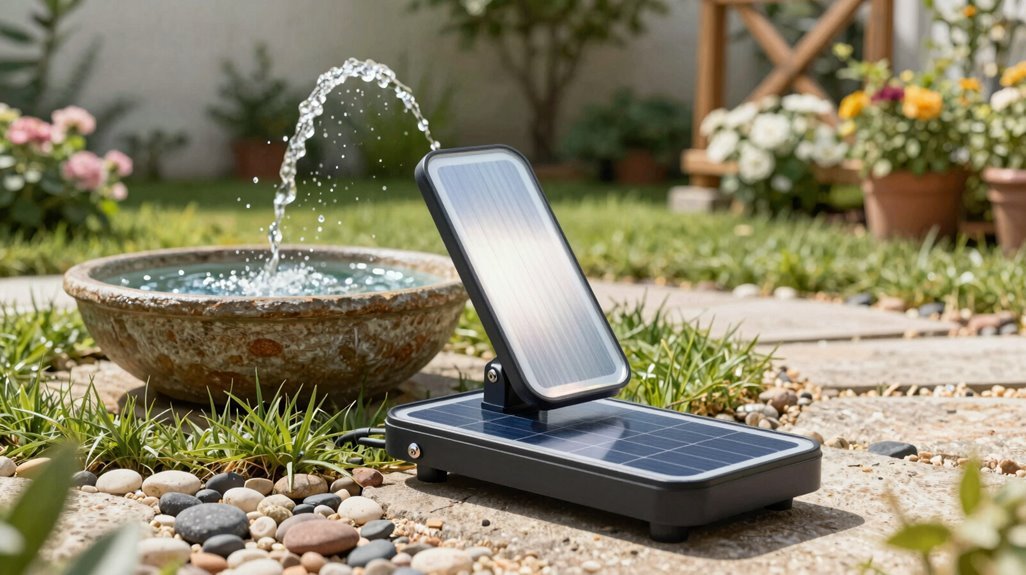
Planting my solar planter fountain taught me something I can’t ignore: the pump I’d grabbed on impulse nearly drowned the snapdragons with its clumsy spray. I’ve learned that solar pump compatibility matters more than I’d assumed, and pump wattage directly shapes your fountain’s personality.
I recommend a 1.5W submerged pump with a ten-foot cord, letting your panel bask while the motor stays hidden beneath hexagon-tiled backdrops or stone pillar fountains.
| Feature | Why It Matters |
|---|---|
| Pump wattage | Controls spray height and pervious filtration needs |
| Nozzle options | Shapes the water’s dance, whether bell, jet, or tiered |
| Solar fountain kit | Bundles panel, pump, and cord for simplicity |
| Submerged pump | Runs quieter, avoids mechanical eyesores |
| Battery backup | Extends operation past sunset, through cloudy spells |
I source my solar fountain kit online, weighing delivery times against cost. With proper nozzle options selected, my stone pillar fountain now murmurs rather than splashes, and the snapdragons do well.
Position Your Fountain for Maximum Sun
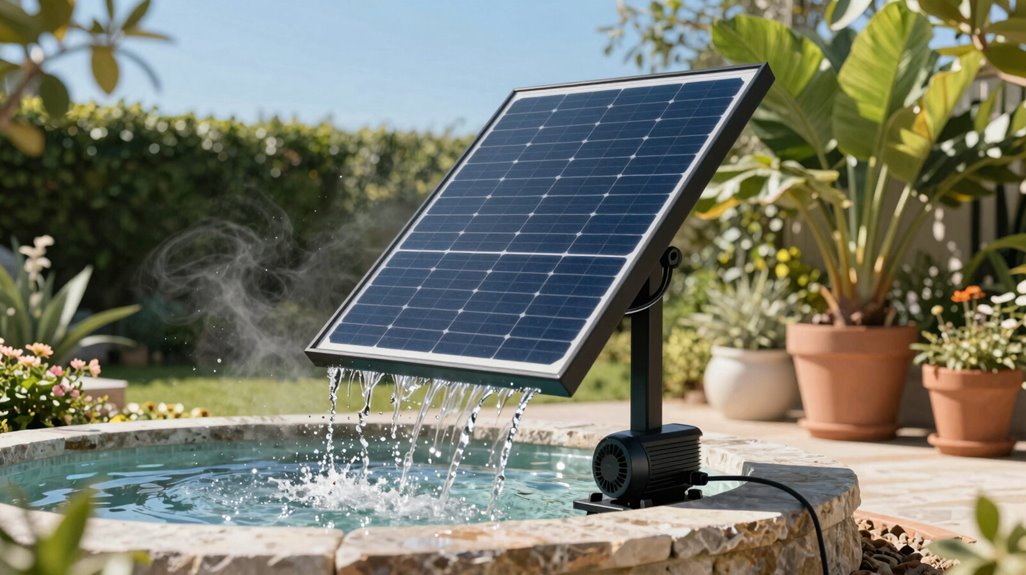
Because I’d already wrestled with a half-submerged pump gasping under lily pad shade, I learned quickly that panel placement isn’t an afterthought; it’s the engine beneath every hum and spray.
I stake my solar panel placement in full, blazing sun, ensuring unobstructed cord length stretches ten feet without kinks or shadows that choke the current. During adjustments, I shade the panel temporarily; dry pumps whir toward burnout. I pivot back to maximize sun exposure once water flows.
I fill my stone vessel halfway, letting pump orientation sit deep enough that evaporation won’t leave it gasping by afternoon. I angle the panel toward peak daylight, even when fountain positioning faces away from my hexagon-tiled patio, because performance outweighs the view.
Hide Cords and Secure Rocks for a Clean Look
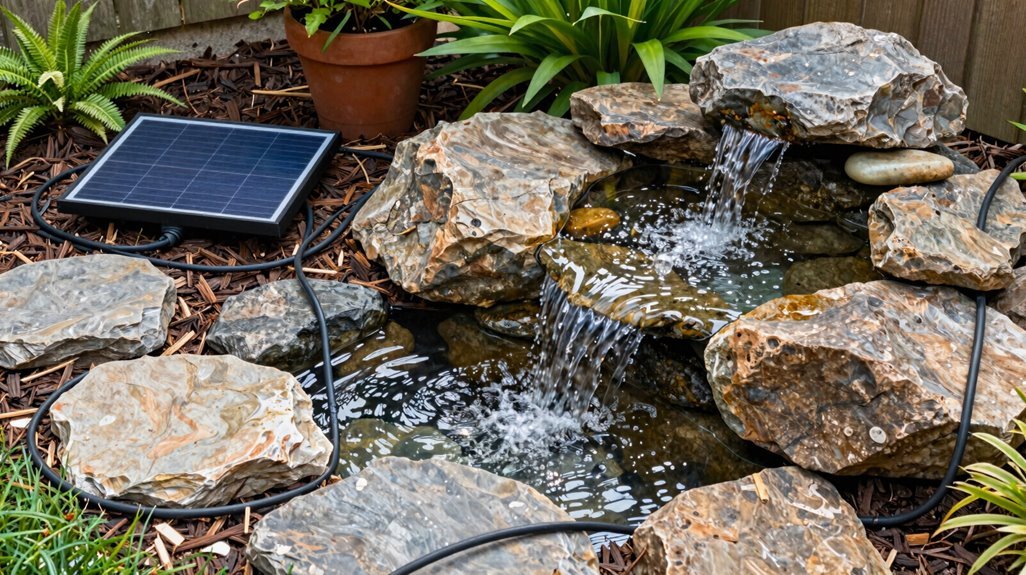
Where does the eye travel first when I step back from a finished fountain? I’ll tell you: straight to every messy cord and wobbling rock that breaks the illusion. That’s why I take time to hide cords and secure rocks for a clean look that actually earns its place in my backyard décor.
| Cord Location | Concealment Method | Visual Result |
|---|---|---|
| Base perimeter | Stacked river rock | Seamless ground transition |
| Panel to pump | Routed behind hexagon-tiled backdrop | Uninterrupted sight line |
| Reservoir lip | Suction cup attachment, cord draped discretely | Minimal surface disruption |
| Planter edge | Hidden by stone pillar fountain or bunny statue | Whimsical, intentional placement |
| Vessel bottom | Drilled pervious drainage, sealed filtration zone | Technical reliability, hidden function |
When I secure rocks around my solar fountain’s base, I nestle them until the pump housing vanishes entirely. The cord follows natural contours, never crossing open space where it would break the garden’s peace.
Mine belongs because I’ve made it belong.
Keep Your Solar Fountain Water Clean and Bug-Free

Once I’ve got the rocks locked in and the cords vanishing into the landscape, I turn my attention to what actually flows through the fountain: the water itself.
- Moving water defeats mosquitoes, I keep the solar pump running consistently, since circulating water disrupts the shallow water habitat where they’d otherwise lay eggs.
- Plants oxygenate naturally, I tuck water lettuce into my pervious basin, letting roots filter while improving water cleanliness.
- Panel positioning matters, I angle the solar collector toward open sky, submerging the pump fully to prevent overheating during peak hours.
- Gentle cleaning preserves function, I rinse components weekly, using diluted vinegar when algae appears, prioritizing solar pump care through mindful solar fountain maintenance.
This rhythm keeps my hexagon-tiled backdrop flowing clear, inviting fellow gardeners to gather and belong.
Fix Weak Spray, Green Water, and Pump Burnout
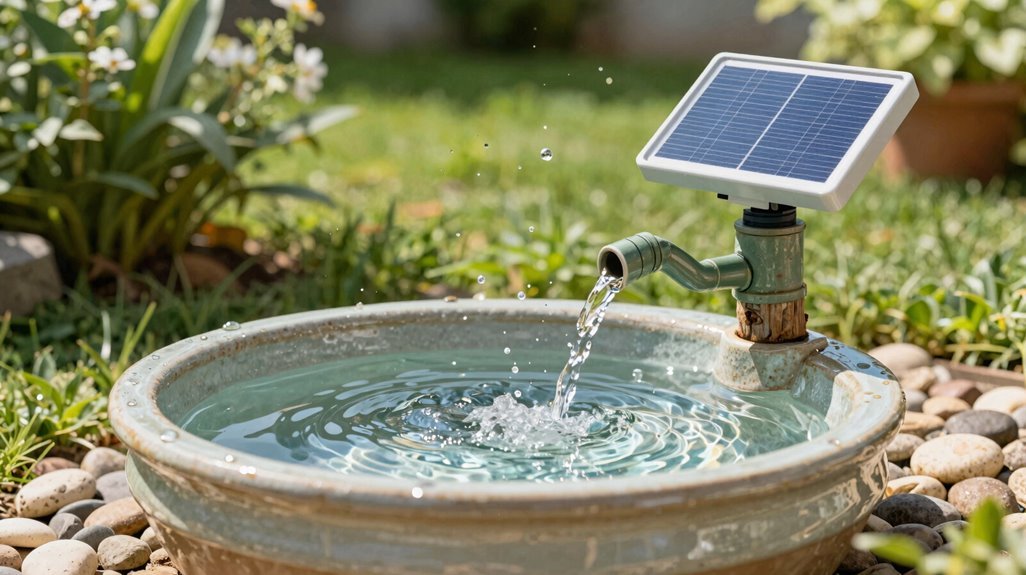
I’ve run into weak spray shooting sideways from my stone pillar fountain, and it’s usually because the intake’s clogged with leaves or the water’s too shallow; keeping the basin about half full and clearing that pervious filter mesh fixes it most times. When the hexagon-tiled backdrop behind my basin starts slicking over with green film, I know I’ve let sunlight and nutrients run unchecked without enough filtration or plant shade to starve that algae out.
Let’s tackle how you’ll diagnose these mechanical and biological failures before they tax your pump past recovery.
Weak Spray Solutions
Adjusting a solar fountain’s spray pattern often reveals how finicky these compact systems can be, especially when you’re standing in your garden at noon, watching the water barely crest above the lily pads. I’ve learned that weak spray usually stems from fixable issues we all encounter.
- Check your water depth: I make sure my solar fountain sits submerged with at least two inches covering the pump, since insufficient depth starves the system.
- Clean the pump intake: I rinse filtration screens weekly, because debris buildup chokes flow faster than you’d expect.
- Optimize sun exposure: I reposition panels until spray height peaks, avoiding shade that saps performance.
- Mind the heat: I angle panels to prevent pump burnout, cooling the mechanism while maintaining direct light.
These adjustments keep my stone pillar fountain dancing, pervious to afternoon breezes.
Green Water Fixes
Why does my crystal-clear basin turn murky green within days, the water thickening like pea soup until the solar fountain pump strains against the sludge? I’ve battled this pervious enemy myself, and algae thrives on stagnation, colonizing every surface with a slick, chartreuse film that chokes filtration and dulls spray patterns.
Preventing green water demands consistent maintenance: I skim debris with a fish tank net, trace hexagon-tiled backdrop reflections for early blooms, and rinse components in diluted vinegar, careful not to overdo it. My stone pillar fountain stays pristine when I maintain proper water depth, keeping the pump submerged two inches minimum to prevent dry-running burnout.
Positioning panels in direct sun drives circulation, disrupting mosquito breeding and algae settlement, and shared vigilance keeps our garden waters crystalline.
Pick Plants That Look Good and Stay Put

Wherever I’ve placed a solar fountain, I’ve learned that plant selection makes or breaks the entire composition. I’ve found that solar fountain plants with strong root systems create aquatic stability, anchoring the visual weight of a container water garden without drifting into the spray pattern.
Anchor with structural specimens: I use Cyperus involucratus Baby Tut, Taro, and Canna Lily; their fibrous masses grip substrate, resisting displacement from circulating currents.
Employ plant pots inside tubs: I nest plastic nursery containers within larger vessels, capping them with pea gravel and river stone to prevent soil migration.
Integrate water lettuce filtration: I float these rosettes strategically, their dangling roots absorbing excess nutrients while softening hard edges.
Position for pump harmony: I place specimens where solar panels catch uninterrupted light, keeping foliage clear of spray arcs and thermal stress zones.